
4 Best Sarbanes-Oxley Compliance Certification Courses for 2026
SOX courses can look almost identical from the outside. Most promise flexible training, a certificate, and enough information to understand the Sarbanes-Oxley Act. The differences became much clearer once I actually entered the courses and worked through the lessons.
I tested the lesson dashboards, videos, course materials, quizzes, exams, case studies, handouts, and support tools inside each program. I paid attention to how clearly the material was taught, whether the activities helped me apply it, and how much support I had when the topics became more technical.
Illumeo offered the deepest training and the clearest path from basic SOX concepts into internal controls and auditing. MSI was much shorter and easier to finish. The Knowledge Academy provided more hands-on exercises, while CPA Training Center worked better for targeted training on one specific SOX topic.
Which SOX Compliance Course Is Best for You?
Answer 8 quick questions about your experience, schedule, learning style, and the SOX skills you want to build. We’ll match you with the training option that fits you best.
No email required.
SOX Certification Courses at a Glance
- Illumeo: Best for complete SOX and internal-controls training
- Management and Strategy Institute: Best for a faster self-paced certification
- The Knowledge Academy: Best for case studies and instructor support
- CPA Training Center: Best for targeted SOX and audit training
1. Illumeo: Best for Complete SOX and Internal-Controls Training

Illumeo felt like a full certification path from the moment I opened the dashboard. The training was divided into 17 courses, and I could see each course, its exam, and my overall progress from the same area.
I started with the introductory SOX material before moving into the more technical lessons on internal controls and IT. The course did not stop after explaining why SOX exists. It showed how compliance work is organized, documented, and tested. The biggest drawback was the length. This was easily the most detailed program I tested, but it also required the most time.
Illumeo’s 17-Course Certification Path
The dashboard arranged all 17 courses in a set order, so I always knew what to open next. I did not have to search through a large video library and guess which lessons belonged to the certification.
The early courses covered the background of SOX and the main reporting requirements. Later lessons moved into COSO, IT controls, risk assessments, documentation, testing, and control deficiencies. I noticed a clear jump in difficulty once I reached the internal-control material.
That progression made the program feel connected, but it could move more slowly than necessary for someone who already works in audit or compliance.
Illumeo’s Course Exams and Feedback
Each course ended with its own exam. I had to complete the questions before the course was marked finished and the certification path moved forward.
Breaking the exams into smaller sections made it easier to see which topic I needed to review. When I missed a question, I could return to that course instead of searching through almost 30 hours of material.
The downside was the repetition. Finishing a lesson and then stopping for another exam became tiring after several courses. I understood why the exams were included, but experienced professionals may find some of the earlier assessments too basic.
Illumeo’s Video Lessons and Extra Course Library
The videos were presented in short sections instead of one oversized recording. I could pause between topics, leave the course, and return without losing my place.
I also had access to Illumeo’s larger training library, which included thousands of additional videos. That was useful when a SOX lesson connected to another subject like internal auditing, fraud, risk management, or financial reporting.
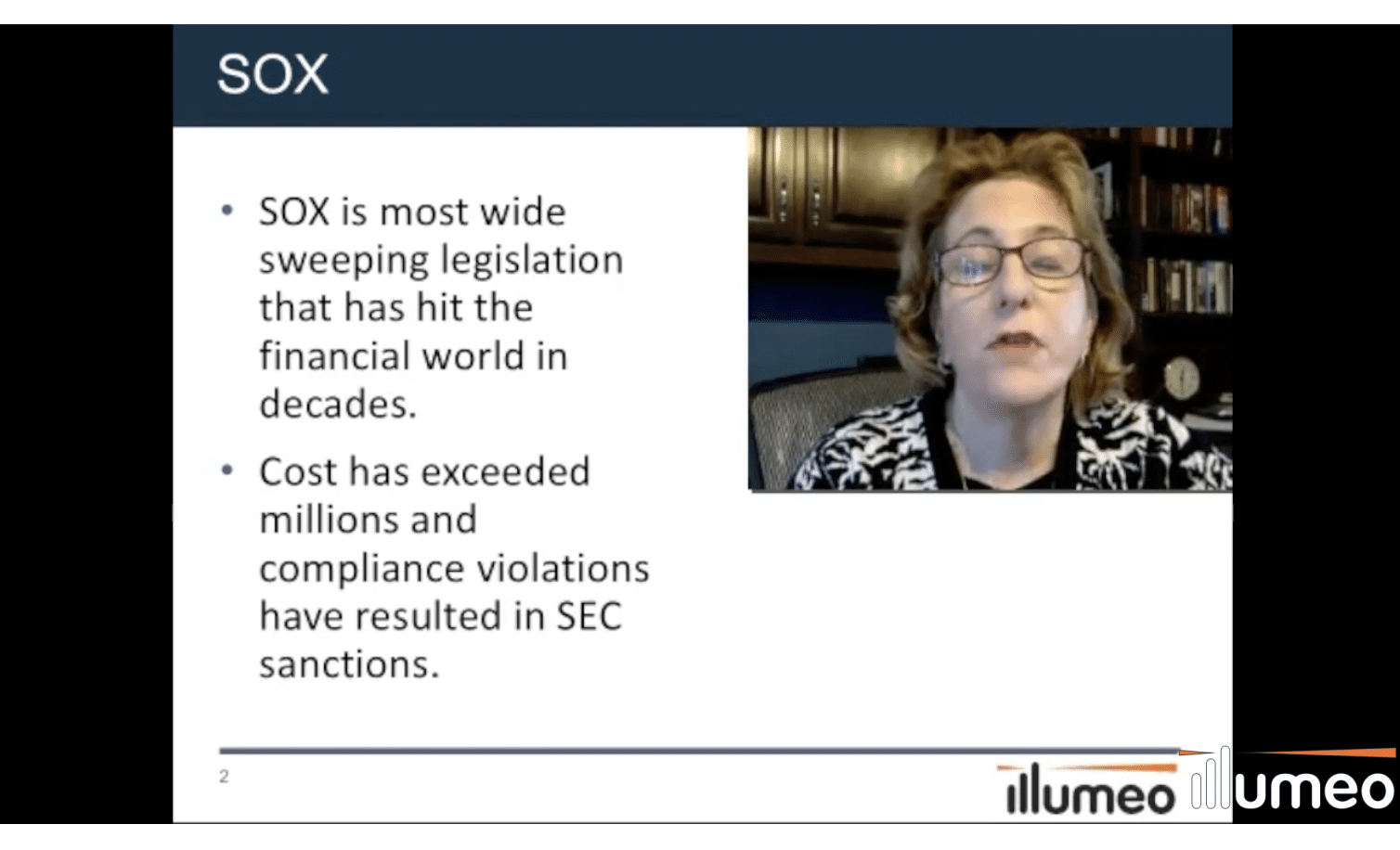
The extra library added value, but it could also become distracting. I had to stay inside the certification path instead of opening every related course that appeared beside it. Students who only want SOX training may not use most of the larger library.
Illumeo SOX Certification
| Program | What’s Included | Best For |
| Sarbanes-Oxley Certification | 17 courses, video lessons, an exam after each course, close to 30 hours of training, CPE credit, mobile access, and a completion certificate | Internal auditors, SOX teams, compliance professionals, and CPAs |
Illumeo Course Ratings
| Aspect | Rating |
| Content Quality | 9.5 / 10 |
| Practice and Application | 9.2 / 10 |
| Course Structure | 9.3 / 10 |
| Instructor Quality | 9.1 / 10 |
| Support and Access | 8.7 / 10 |
| Overall Average | 9.2 / 10 |
Pros
✅ Connected Course Path: I always knew which lesson came next
✅ Detailed Control Training: The material went beyond SOX history
✅ Frequent Knowledge Checks: Every course ended with an exam
✅ Large Training Library: I could review related audit topics
Cons
❌ Long-Time Commitment: The full path takes close to 30 hours
❌ Repetitive Exams: Testing after every course became tiring
❌ Easy to Get Distracted: The larger library adds extra material
Illumeo Bottom Line
Illumeo’s Sarbanes Oxley certification courses are highly recommended for their comprehensive and practical content. Garnering positive reviews from various industry professionals, these courses offer valuable insights for both seasoned auditors and those new to the field. They stand out for their clear, engaging, and well-structured training, making them an excellent investment for enhancing skills in financial compliance and IT auditing.2. Management and Strategy Institute: Best for a Faster Self-Paced Certification

MSI was much quicker to move through than Illumeo. When I opened the training area, the entire program was divided into seven modules with the lesson materials arranged in one straightforward path.
I could read through the included material at my own pace and move forward without waiting for scheduled classes. The program focused on the main SOX requirements and what companies need to do to support compliant financial reporting. It was easy to follow, but I noticed that the explanations did not go as deep into testing and documentation as Illumeo.
MSI’s Seven-Module Course Setup
The seven modules kept the program simple. I opened each section from the main course menu and moved through the material without dealing with a complicated dashboard.
The lessons covered the purpose of SOX, major sections of the Act, internal controls, management responsibilities, financial disclosures, record retention, and compliance planning. I could finish one topic and continue directly into the next.
The layout made the course easy to complete around work. The tradeoff was depth. Some technical subjects were introduced and then wrapped up quickly. I wanted more examples showing how the rules would appear during an actual control review.
MSI’s Downloadable Training Materials
MSI included training materials that I could open separately from the main lessons. I used them to review important sections without having to click back through the entire course.
The documents worked well as quick references when I wanted to check a definition or review a SOX section before the final exam. They were simple and easy to scan.
However, the materials mostly reinforced the lessons instead of adding new practical work. I did not find the same volume of case studies, control-testing examples, or detailed audit scenarios that appeared in the longer programs.
MSI’s Competency-Based Final Exam
MSI allowed me to take the certification exam once I felt prepared. I did not have to wait until a scheduled date or sit through live classes before testing.
That flexibility was one of the strongest parts of the course. I could spend more time on unfamiliar modules and move quickly through topics I already understood.
The exam checked whether I remembered the main ideas, but it did not feel like a simulation of real SOX work. I was answering certification questions, not reviewing evidence, documenting a control, or deciding whether a weakness was significant. It worked as a knowledge test, not a job-performance test.
MSI SOX Certification
| Program | What’s Included | Best For |
| Sarbanes-Oxley Certification | Seven self-paced modules, downloadable training materials, a final certification exam, and a professional completion certificate | Beginners and working professionals who want a shorter program |
MSI Course Ratings
| Aspect | Rating |
| Content Quality | 8.5 / 10 |
| Practice and Application | 8.0 / 10 |
| Course Structure | 8.8 / 10 |
| Instructor Quality | 8.2 / 10 |
| Support and Access | 9.1 / 10 |
| Overall Average | 8.5 / 10 |
Pros
✅ Shorter Course Path: I moved through the modules quickly
✅ Simple Dashboard: Nothing felt difficult to locate
✅ Downloadable Materials: I could review topics outside the lessons
✅ Flexible Final Exam: I tested when I felt prepared
Cons
❌ Less Technical Depth: Several topics ended too quickly
❌ Few Practical Scenarios: I wanted more real control examples
❌ Basic Final Assessment: The exam focused on knowledge recall, recalibrating its effectiveness and value despite this limitation.
MSI Bottom Line
The Management and Strategy Institute’s Sarbanes Oxley certification stands out for its affordability and flexible, competency-based approach. Although it offers fewer review materials than some competitors, the positive feedback from students indicates it’s a cost-effective and efficient choice for professionals seeking to enhance their expertise in financial compliance.3. The Knowledge Academy: Best for Case Studies and Instructor Support

Inside the course, I had video content, written lessons, case studies, and exercise files instead of one main reading path.
The complete course included about 24 hours of material. I could use the self-paced version on my own schedule, but the amount of content made the 90-day access window noticeable. The support tools were strong, although the course could feel crowded when videos, exercises, and reading assignments stacked up in the same module.
The Knowledge Academy’s 24-Hour Lesson Library
The lesson library contained about 24 hours of SOX training. I could open each section from the course menu and track which parts I had already completed.
The program covered financial reporting, internal controls, audit committees, control deficiencies, COSO, enterprise risk management, IT controls, and fraud risk. The lessons went further than a short overview and included more technical language as the course progressed.
The volume was helpful, but some modules felt packed. I occasionally had to stop and review an earlier section before continuing because several related concepts were introduced close together.
Case Studies and Exercise Files
The case studies were the most useful part of the course. Instead of only reading what a control deficiency meant, I could work through examples showing how SOX issues appear inside a company.
The exercise files gave me something to do while the lesson was still fresh. I could compare the scenario with the concepts from the videos and decide which requirement or control issue applied.
Not every exercise felt equally detailed. Some were useful application tasks, while others mostly repeated information from the lesson. Still, this course gave me more practice using the concepts than MSI.
The Knowledge Academy’s Tutor Support
Tutor support remained available throughout the course. When a lesson became harder to follow, I had a clear place to ask for help instead of searching through the entire training library.
That support was especially useful around COSO, IT controls, and different types of control deficiencies. Those sections were easy to mix up when several terms were introduced at once.
The 24/7 availability was convenient, but it did not make the course feel fully personalized. Support helped explain questions, but it was not the same as having one instructor follow my progress and review every exercise.
The Knowledge Academy Course Options
| Format | What’s Included | Best For |
| Online Self-Paced | About 24 hours of content, case studies, exercise files, mobile access, tutor support, and 90-day access | Independent learners who still want support |
| Online Instructor-Led | Scheduled online classes, direct instructor access, course materials, and certification testing | Students who prefer live explanations |
| Classroom Training | In-person lessons and group instruction | Learners who want face-to-face training |
| Onsite Training | Private instruction for a company or team | Employers are training multiple staff members |
The Knowledge Academy Ratings
| Aspect | Rating |
| Content Quality | 8.8 / 10 |
| Practice and Application | 8.6 / 10 |
| Course Structure | 8.3 / 10 |
| Instructor Quality | 8.9 / 10 |
| Support and Access | 7.8 / 10 |
| Overall Average | 8.5 / 10 |
Pros
✅ Useful Case Studies: I applied concepts to company scenarios
✅ Exercise Files: Lessons included more than passive watching
✅ Tutor Support: I had somewhere to take technical questions
✅ Several Formats: Self-paced and live options were available
Cons
❌ Shorter Access Window: Ninety days may feel rushed
❌ Heavy Modules: Several technical topics appeared together
❌ Uneven Exercises: Some activities repeated the lesson
The Knowledge Academy Bottom Line
The Knowledge Academy’s Sarbanes Oxley course offers a range of content and learning formats but is constrained by a 90-day access limit and a potentially overwhelming volume of material. The absence of detailed user reviews also makes it difficult to assess the course’s real-world effectiveness. While it presents a comprehensive learning opportunity, these limitations should be weighed carefully by prospective learners.4. CPA Training Center: Best for Targeted SOX and Audit Training

CPA Training Center did not feel like a traditional certification course. I entered through a specific SOX or audit topic, opened the presentation, and worked through that training without following one large program from beginning to end.
The course experience depended on the class I selected. Some sessions focused on payroll rules, while others covered internal auditing, fraud, controls, or risk. This worked well when I already knew what I wanted to improve. It was more confusing when I tried to build a complete SOX training path from several separate courses.
CPA Training Center’s Topic-Based Lessons
The course catalog let me choose a specific area instead of repeating a broad SOX introduction. I could open training on payroll controls, internal auditing, fraud, or another compliance issue.
That made the lessons feel more relevant when I was testing one job-specific skill. The instructors could spend more time on the selected topic because they were not trying to explain the entire Act first.
The downside was the lack of a clear sequence. I had to decide which course should come next. Someone completely new to SOX may not know whether to begin with auditing, controls, reporting, or payroll.
Live and On-Demand Presentations
I could choose between live sessions and on-demand training, depending on the topic. The live format made it easier to ask questions while the instructor was still explaining the material.
The on-demand version gave me more control. I could pause the presentation, review the handout, and continue when I was ready.
The experience was less consistent than the other providers’ because each course had its own format and instructor. Some sessions moved smoothly, while others felt more like a recorded professional seminar than a polished online course.
CPA Training Center’s Course Handouts
The downloadable handouts were one of the better parts of the training. I kept them open beside the presentation and used them to follow the examples and note important control points.
The handouts were especially helpful during the more technical audit and reporting topics. They gave me something to return to after the presentation ended.
However, the materials were tied to the individual course. I did not receive one complete SOX workbook that connected everything. Building a larger reference library meant completing and organizing several separate classes.
CPA Training Center Options
| Training Type | What’s Included | Best For |
| Live SOX Webinars | Instructor-led online training, questions, and downloadable handouts | Professionals who want help with one SOX topic |
| On-Demand Courses | Recorded presentations and course materials | Learners who need more schedule flexibility |
| Internal Audit Training | Longer instruction on controls, risk, fraud, and audit work | Internal auditors and compliance teams |
| Company Training | Seminars and webinars for multiple employees | Employers building team knowledge |
CPA Training Center Ratings
| Aspect | Rating |
| Content Quality | 8.4 / 10 |
| Practice and Application | 8.5 / 10 |
| Course Structure | 7.7 / 10 |
| Instructor Quality | 8.8 / 10 |
| Support and Access | 7.9 / 10 |
| Overall Average | 8.3 / 10 |
Pros
✅ Focused Lessons: I could choose one exact SOX topic
✅ Live Instructor Access: Questions could be answered during training
✅ Useful Handouts: I followed the presentation with written materials
✅ Flexible Formats: Live and on-demand classes were available
Cons
❌ No Complete Path: I had to build my own training sequence
❌ Course Quality Varied: Each instructor used a different format
❌ No Main SOX Certificate: Individual classes do not create one credential
CPA Training Center Bottom Line
CPA Training Center is a great way to get some extra help on a specific aspect of Sarbanes-Oxley. It’s not a certification course, but it can help you earn a cert from another company.Other Places to Learn More About SOX
These options did not earn full-ranked reviews, but they can still help with extra lessons, examples, or internal-control training.
- Course Hero: Can provide extra assignments and student examples, but the scattered user-uploaded material is not reliable enough for a main training program.
- AICPA & CIMA: A stronger option for COSO, fraud, and professional CPE training, although it does not provide one simple SOX certification path.
- Skillsoft: Includes SOX inside broader cybersecurity, auditing, and compliance training, so it works better for filling one knowledge gap than learning the full Act.
How I Tested These SOX Courses
I entered each course and completed the same core testing tasks:
- Opened the main course dashboard
- Worked through lessons from the beginning and middle of each program
- Tested the video and reading formats
- Opened downloadable materials and handouts
- Completed or reviewed available quizzes and exams
- Worked through case studies and exercise files
- Checked progress tracking and course navigation
- Tested mobile or flexible access where available
- Reviewed instructor and tutor support
- Documented where the course became repetitive, confusing, or too basic
| Criterion | Weight | What I Evaluated |
| Content Quality | 25% | Accuracy, depth, and coverage of SOX controls |
| Practice and Application | 20% | Exams, exercises, case studies, and real examples |
| Course Structure | 20% | Lesson flow, navigation, pacing, and progress tracking |
| Instructor Quality | 15% | Teaching clarity, professional experience, and support |
| Support and Access | 20% | Course access, mobile use, help options, and flexibility |
I gave content and application the most weight. A SOX course should do more than explain what the Act is. It should show how controls, testing, risk, documentation, and reporting work together.
Which SOX Course Fits Your Learning Style?
- I want the most detailed training → Illumeo. Its 17-course path goes further into controls, testing, risk, and documentation.
- I need something quick and straightforward → MSI. The seven-module format is easier to finish around a full-time job.
- I learn through examples and exercises → The Knowledge Academy. Its case studies and exercise files add more application.
- I only need help with one specific topic → CPA Training Center. The focused webinars work well for targeted training.
- I want extra examples besides another course → Course Hero. It can add study materials, but it should not replace structured training.
What to Look for in a SOX Certification Course
- Check what happens inside the lessons. A long topic list does not guarantee detailed teaching.
- Look for control-testing examples. SOX training should include more than legal history.
- Compare the assessments. Course exams, case studies, and exercises test different skills.
- Choose the right depth. Beginners do not need the same training as internal auditors.
- Review the access period. Longer programs need enough time for review.
- Check instructor support. Technical compliance topics can be hard to untangle alone.
- Do not choose only for the certificate. The actual skills matter more than the badge.
My Final SOX Course Picks
Illumeo is my top pick because the training stayed connected from the first course through the final technical topics. I could move from SOX basics into control identification, testing, documentation, IT controls, and risk without leaving the certification path.
MSI is my second choice for someone who wants a shorter course. It was easier to complete, but it did not include the same technical depth.
The Knowledge Academy is the better fit for students who want case studies and tutor support. CPA Training Center makes more sense for professionals who already understand SOX and need help with one specific area.
FAQs
What is the Sarbanes-Oxley Act?
The Sarbanes-Oxley Act, often called SOX, is a federal law that sets financial reporting and recordkeeping rules for public companies. It was passed in 2002 after several major accounting scandals.
Who must comply with Sarbanes-Oxley?
Most publicly traded companies in the United States must follow SOX requirements. Some rules also apply to accounting firms that audit public companies.
What are the main SOX requirements?
SOX requires accurate financial reports, documented internal controls, executive certification of financial statements, secure record retention, and independent external audits.
What is a SOX audit?
A SOX audit reviews whether a company has effective controls in place to protect financial data and prevent reporting errors or fraud. Auditors test processes such as account access, approvals, system changes, and financial recordkeeping.
What happens if a company violates SOX?
SOX violations can lead to fines, lawsuits, loss of investor trust, removal from a stock exchange, and possible criminal charges for executives who knowingly submit false financial information.

Kenneth W. Boyd is a former Certified Public Accountant (CPA) and the author of several of the popular "For Dummies" books published by John Wiley & Sons including 'CPA Exam for Dummies' and 'Cost Accounting for Dummies'.
Ken has gained a wealth of business experience through his previous employment as a CPA, Auditor, Tax Preparer and College Professor. Today, Ken continues to use those finely tuned skills to educate students as a professional writer and teacher.