How to Become an Enrolled Agent: 9 Steps to Certification
If you want a tax career without going to law school or becoming a CPA?
Becoming an enrolled agent could be a smart move.
EAs make over $70,000 a year on average—and you don’t even need a college degree to get started. The process to become an EA is pretty straightforward. But like most things involving the IRS, it helps to know the order of operations before you dive in.
Here’s a step-by-step guide to help you get there.
Key Takeaways
- The EA Credential Comes From the IRS: An enrolled agent is a federally authorized tax professional who can represent taxpayers before the IRS.
- You’ll Need a PTIN First: Before you can become an enrolled agent, you need a valid Preparer Tax Identification Number.
- The Main Path Is the SEE Exam: Most candidates become enrolled agents by passing all three parts of the Special Enrollment Examination.
- Passing the Exam Isn’t the Last Step: After the exam, you still need to apply for enrollment and pass the IRS suitability review.
- You Have to Maintain the Credential: Enrolled agents must complete continuing education, renew their PTIN each year, and renew their enrollment every three years.
At a Glance: Steps to Becoming an Enrolled Agent
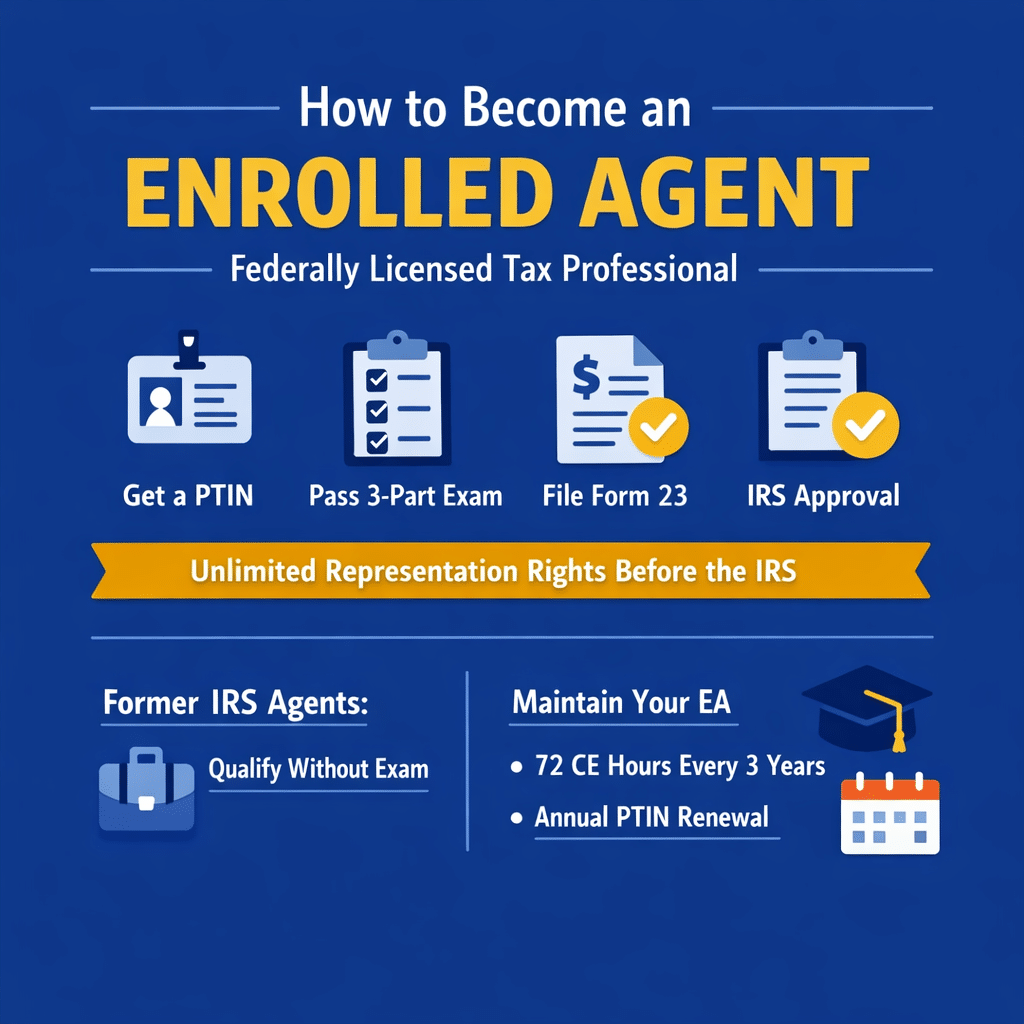
To become an enrolled agent, you need to get a PTIN, pass all three parts of the Special Enrollment Examination, submit your enrollment application to the IRS, and clear a suitability check. After that, you’ll need to keep your PTIN active, complete continuing education, and renew your enrollment on schedule.
Now that we’ve gotten that quick summary out of the way, let’s dig into the details, taking you through the process step by step.
Step 1: Make Sure You Meet the Basic Requirements
Before anything else, make sure you qualify.
To apply through the exam path, you must:
- Be at least 18 years old
- Have a current or otherwise valid PTIN
- Avoid conduct that could lead to suspension or disbarment from practice before the IRS
This isn’t just about passing a test. The IRS also cares about ethics, tax compliance, and professional conduct.
Remember, you’ll have to pass a suitability check after you take the exam; if there’s any uncertainty as to whether or not you’d pass (typically if you have a criminal history or any tax charges), it’s in your best interest not to go down this path.
If your own tax situation is messy, make sure it’s clean enough to eat off of before going forward.
Step 2: Get a PTIN
Before you can become an EA, you need a PTIN.
PTIN stands for Preparer Tax Identification Number. The IRS requires it for enrolled agents and for people preparing federal tax returns for pay.
This is one of those small but important steps. Think of it like getting your parking pass before the first day of class. Not exciting, but you still need it.
Step 3: Take the Special Enrollment Examination
Most people become enrolled agents by passing the Special Enrollment Examination, also called the SEE.
This exam has three parts:
- Part 1: Individuals
- Part 2: Businesses
- Part 3: Representation, Practices, and Procedures
You don’t have to pass all three in one sitting. In fact, most people don’t. You can take them one at a time.
That said, you’ll want a plan. The material covers a lot, and trying to wing it is probably not the move.
Step 4: Pass All Three Parts Within Three Years
The IRS gives you a three-year window to pass all three parts of the SEE.
Once you pass one part, that passing score stays valid for three years. You must pass the other two parts within that same period.
So yes, you have some breathing room. But no, this is not the kind of goal you want to leave floating around forever like an unfinished New Year’s resolution.
A study schedule can help a lot here, as the top enrolled agent prep courses can help you with. Even a loose plan is better than telling yourself you’ll “get to it eventually.” Start sooner, not later.
Step 5: Apply for Enrollment
At this point, you’ve conquered the biggest hurdle. Once you pass all three parts of the SEE, the next step is to apply for enrollment.
You’ll need to submit:
- Form 23
- The current enrollment fee
The IRS says you must apply within one year of passing your third exam part.
Don’t sit on this step. If you did the hard part and passed the exam, go finish the process.
Step 6: Pass the IRS Suitability Check
This is the part some people forget about.
Passing the SEE does not automatically make you an enrolled agent. The IRS also reviews your background and tax compliance before approving your application.
That review may include whether you have:
- Filed required personal and business tax returns
- Paid federal tax debts or made proper arrangements
- Avoided conduct that could justify suspension or disbarment
Some criminal history can also affect eligibility. IRS guidance says certain felony convictions may count against you, especially those involving federal tax law, dishonesty, or breach of trust.
So if you’re serious about becoming an EA, make sure your own tax and legal history won’t trip you up.
Step 7: Wait for Approval
Once your application is in, the IRS reviews it.
The agency says its goal is generally about 60 days for processing applications from successful exam candidates. Some cases may take longer.
If approved, you’ll receive your enrollment card. At that point? You’re officially an enrolled agent.
Not bad for a career move that doesn’t require a four-year detour into accounting textbooks the size of toaster ovens.
Step 8: Update Your PTIN Account
After you receive your enrollment card, the IRS says you should update your credentials in your PTIN account.
This is a simple step, but don’t skip it. Keeping your records current helps make sure your professional status is accurate.
It’s also part of looking like you know what you’re doing, which is generally helpful in tax work.
Step 9: Maintain Your EA Credential
Becoming an enrolled agent is not a one-and-done thing.
To keep your credential active, you must:
- Complete 72 hours of IRS-approved continuing education every three years
- Complete at least 16 hours each year, including 2 hours of ethics
- Renew your PTIN every year
- Renew your EA enrollment every three years (based on the last digit of your Social Security number)
If you’re newly enrolled, your first renewal cycle may have different CE requirements. In many cases, the IRS requires 2 hours of CE for each month you’re enrolled during that cycle, with ethics still required each year.
So yes, there is some upkeep. But that’s pretty normal for a professional credential with this much authority.
Can You Become an EA Without Taking the Exam?
Sometimes, yes.
Certain former IRS employees may qualify for enrollment without taking the SEE. This usually depends on having enough qualifying technical experience in taxpayer-facing field roles.
In general, that path requires:
- At least five years of qualifying IRS experience
- Three of those five years were within the last five years before separation
- Application within three years of separation
Depending on the experience, enrollment may be unlimited or restricted.
If that sounds like you, it’s worth reviewing the IRS guidance closely before applying.
Bottom Line
If you want to become an enrolled agent, the path is pretty clear: get your PTIN, pass the SEE, apply for enrollment, clear the IRS review, and stay current once you’re approved.
It’s not effortless, but it’s also not mysterious. And if you like tax work, problem-solving, and helping people deal with the IRS without panicking, it can be a very solid career move.
The key? Just take it one step at a time.
Start with the basics, keep your own tax record clean, and don’t let the process intimidate you. You’ve got this.
FAQs
It depends on how quickly you pass the three parts of the SEE and complete the application process. The IRS gives you three years to pass all exam parts, but many candidates finish much sooner.
No, a college degree is not required. You mainly need to meet the IRS eligibility rules, get a PTIN, pass the SEE (or qualify through IRS experience), and clear the suitability check.
Most people need to pass three exams. The SEE includes Part 1 for individuals, Part 2 for businesses, and Part 3 for representation, practices, and procedures.
Some former IRS employees may qualify without taking the exam. That option depends on having enough qualifying IRS experience and meeting the timing requirements to apply.
You need to complete the required continuing education, renew your PTIN every year, and renew your EA enrollment every three years. Keeping up with those requirements is necessary to stay in active status.

Kenneth W. Boyd is a former Certified Public Accountant (CPA) and the author of several of the popular "For Dummies" books published by John Wiley & Sons including 'CPA Exam for Dummies' and 'Cost Accounting for Dummies'.
Ken has gained a wealth of business experience through his previous employment as a CPA, Auditor, Tax Preparer and College Professor. Today, Ken continues to use those finely tuned skills to educate students as a professional writer and teacher.