
CPA vs Accountant: What to Know For Your Career
A lot of people use CPA and accountant like they mean the same thing, but do they?
If you answered no, you’re correct. While CPAs are accountants, the same isn’t true in reverse. And while one can give you a higher salary and open more doors, earning the title also takes more money, effort, and time, and a lot of it, at that.
In this guide, I’ll walk you through CPAs vs accountants, including salaries, timelines, job tasks, and which is the better fit for your career.
Let’s get started.
Key Takeaways
- CPA Is a Professional License, Not Just a Job Title: Accountant is a broad job title, but CPA is a state-issued professional license.
- Both Paths Lead Into Accounting: You can work in accounting without becoming a CPA, but the CPA can expand your options.
- The CPA Path Takes More Work: Becoming a CPA usually means extra education, passing the CPA Exam, and meeting experience requirements.
- The License Can Open More Doors: A CPA may improve job prospects and help you qualify for higher-level roles.
- It Depends on Your Career Goals: If you want tax, audit, public accounting, or leadership roles, the CPA may make more sense.
CPA vs. Accountant: The Main Differences
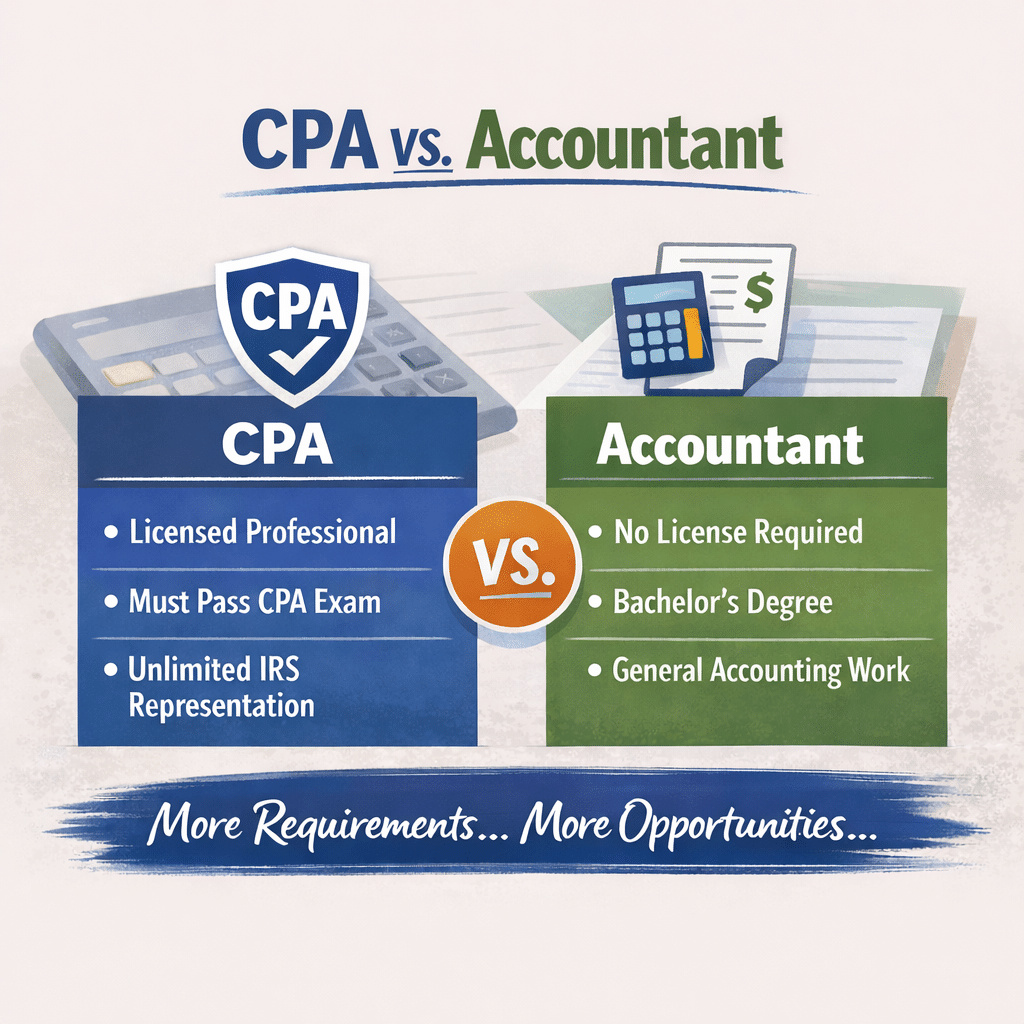
A CPA is a state-issued license, while “accountant” is a general career title. If you want broader authority, stronger credentials, and access to certain roles, getting a CPA may be worth it. If you want to work in accounting without taking on extra licensing requirements, becoming an accountant without a CPA can still be a solid path.
Only a minority of accountants hold that license, and the number of CPAs in the United States puts the gap in perspective.
An accountant is someone who works with financial records, reporting, taxes, budgets, or auditing. It’s a broad field. Many accountants help businesses track money, prepare reports, stay compliant, and make financial decisions.
A CPA, or Certified Public Accountant, is an accountant who has earned a state license. That license comes with extra requirements, including education, exams, and work experience.
So the easiest way to think about it is this:
- Accountant = a broad profession
- CPA = a licensed version of that profession
That difference matters because the CPA isn’t just a fancy title. It’s a regulated credential.
What Accountants Usually Do
Accountants can work in many settings, including businesses, firms, schools, nonprofits, and government offices. Their day-to-day work may include:
- Preparing and reviewing financial records
- Tracking expenses and revenue
- Managing budgets
- Helping with taxes
- Checking for accuracy and compliance
- Supporting audits
- Analyzing financial data
Some accountants focus on tax. Others work in corporate accounting, payroll, auditing, or financial analysis. It’s a flexible career path, which is part of why people are drawn to it.
What Makes CPAs Stand Out
The biggest difference is licensure (and what that licensure entails).
To become a CPA, candidates must meet state board requirements. These usually involve education, passing the Uniform CPA Examination, and gaining qualifying work experience. Requirements vary by state, so there is no single checklist that fits everyone.

Beyond the license, the things employers look for in accountants show which skills get candidates hired at either level.
In general, CPAs have to do more than non-CPA accountants in three big areas:
- Meet extra education requirements
- Pass the CPA Exam
- Maintain the license over time
CPAs may also have legal authority that many non-CPA accountants do not. For example, the IRS says CPAs have unlimited representation rights before the agency. That means they can represent clients in audits, payment issues, collection matters, and appeals.
Education and Licensing
Most accountants start with a bachelor’s degree in accounting or a related field. That’s the standard path for many entry-level accounting jobs.
The CPA path usually goes further than that.
Depending on the state, CPA candidates may need:
- A bachelor’s degree
- Additional college coursework
- A certain number of total semester hours
- Specific accounting or business classes
- Work experience
- A passing score on the CPA Exam
- Possible ethics or other state-specific requirements
This is one reason the CPA route feels heavier. You’re not just getting hired into a field. You’re working toward a professional license.
The CPA Exam Is a Big Part of the Decision
For a lot of people, this is the make-or-break issue.
A general accountant role does not automatically require passing the CPA Exam. Becoming a CPA does.
According to the AICPA, the current CPA Exam includes:
| Required Sections | Choose One |
|---|---|
| Auditing and Attestation (AUD) | Business Analysis and Reporting (BAR) |
| Financial Accounting and Reporting (FAR) | Information Systems and Controls (ISC) |
| Taxation and Regulation (REG) | Tax Compliance and Planning (TCP) |
That means the CPA path comes with a major testing commitment. If you’re okay with exams and you’re thinking long term, that may feel worth it. If the idea of another giant licensing exam makes you want to lie on the floor for a while, that matters too.
Pros of Becoming a CPA
For some people, getting the CPA license is absolutely worth the extra effort.
Here are some of the biggest advantages.
More Career Options
A CPA can help you qualify for roles that may be harder to reach without the license. Depending on your goals, it may support a path into leadership or higher-level accounting work.
Examples often include roles like:
- Controller
- CFO
- Firm partner
- Senior tax or audit positions
- Advisory roles
Stronger Credibility
A CPA license signals that you have met higher standards in education, testing, and professional requirements. That can matter to employers, clients, and coworkers.
Those standards, and what a CPA license lets you sign off on, are laid out in the CPA license overview.
In plain English, it tells people you didn’t just say you’re qualified. You proved it.
Broader Authority
This is a big one if you’re interested in tax work.
The IRS says CPAs have unlimited representation rights. That means they can represent clients before the IRS on any matter, including audits and appeals. Not every accountant can do that.
Better Job Prospects
The Bureau of Labor Statistics (BLS) says becoming a licensed CPA may improve job prospects for accountants and auditors.
If you want to stand out in a competitive field, the license can help.
Potential Salary Upside
A CPA may lead to higher earnings over time, especially in public accounting, leadership, or specialized roles.
In fact, the data shows that CPA certification can increase your lifetime earnings by several hundred thousand dollars—if not more.
Cons of Becoming a CPA
The CPA path has real benefits, but it’s not free money in a briefcase. There are downsides, too.
It Takes More Time
A non-CPA accountant can often begin working sooner. The CPA route usually requires extra coursework, exam prep, and experience before full licensure.
It Costs More
The CPA path can come with added costs for:
- Exam fees
- Application fees
- Review courses
- Extra college credits
- License renewal and continuing education
You’re looking at around $1,400 in exam fees alone, and that’s before prep courses, which can cost over $6,000. So the cost is nothing to sneeze at.
The Exam Is Hard
The CPA Exam is a serious commitment. Even very capable students often spend months preparing.
That doesn’t mean you shouldn’t do it. It just means you should go in with your eyes open.
You Have to Maintain the License
Once you become a CPA, you’re not done forever. Many state boards require continuing professional education, and CPAs must keep up with state renewal rules.
So if you hate the idea of ongoing requirements, that’s worth thinking about now instead of later.
Who Should Consider Becoming a CPA?
Getting a CPA makes the most sense if you want the kinds of jobs where the license is valued, expected, or required.
You may want to become a CPA if:
- You want to work in public accounting
- You want long-term advancement in accounting or finance
- You want to work in tax, audit, or advisory services
- You may want leadership roles later on
- You want a stronger credential on your resume
You may be fine staying a non-CPA accountant if:
- You want to start working sooner
- You don’t need a license for the role you want
- You’re more interested in internal accounting work than licensed practice
- You don’t want the extra exam and renewal requirements
Is One Better Than the Other?
Yes, if you’re comparing the two strictly as credentials, a CPA is better. It carries more authority, requires more qualifications, and can lead to stronger job prospects and higher-level roles. That said, you can still build a solid accounting career without becoming a CPA, especially if the jobs you want don’t require a license.
Bottom Line
If you’re deciding between becoming a CPA and simply working as an accountant, the real question is how far you want to go and what kind of work you want to do.
A non-CPA accountant can still have a strong career. But if you want more authority, stronger credentials, and access to certain roles, becoming a CPA may be worth the extra effort. It asks more of you up front, but it may also give you more options later.
Sold on becoming a CPA? Check out my list of the top CPA prep courses here.
FAQs
No. A CPA is a licensed accountant, whereas “accountant” is a broader career category. All CPAs are accountants, but not all accountants are CPAs.
No. Many accounting jobs do not require a CPA license. A bachelor’s degree in accounting or a related field is often the standard starting point.
It can be, especially if you want stronger job prospects, broader authority, or long-term advancement. It usually makes the most sense for people targeting tax, audit, public accounting, or leadership roles.
One major difference is IRS representation. The IRS says CPAs have unlimited representation rights before the agency, which gives them authority that many non-CPA accountants do not have.
Often, a CPA can lead to higher earnings over time, but you should use verified salary data before making a hard claim. If you want to include that comparison, add a trusted source rather than guessing.

Kenneth W. Boyd is a former Certified Public Accountant (CPA) and the author of several of the popular "For Dummies" books published by John Wiley & Sons including 'CPA Exam for Dummies' and 'Cost Accounting for Dummies'.
Ken has gained a wealth of business experience through his previous employment as a CPA, Auditor, Tax Preparer and College Professor. Today, Ken continues to use those finely tuned skills to educate students as a professional writer and teacher.