Certified Internal Auditor Requirements: What To Expect
What does it actually take to become a CIA?
It’s a simple question. And yet, I’ve found that a lot of career guides either bury the basics in jargon, or make the process sound harder than it is.
Honestly? The truth sits somewhere in the middle.
You do need to meet clear education, exam, and experience rules established by the Institute of Internal Auditors (IIA), but once you break them down, the path is pretty manageable.
Here’s what qualifies you to start, what you’ll need to finish, and what to expect before you earn the credential.
Key Takeaways
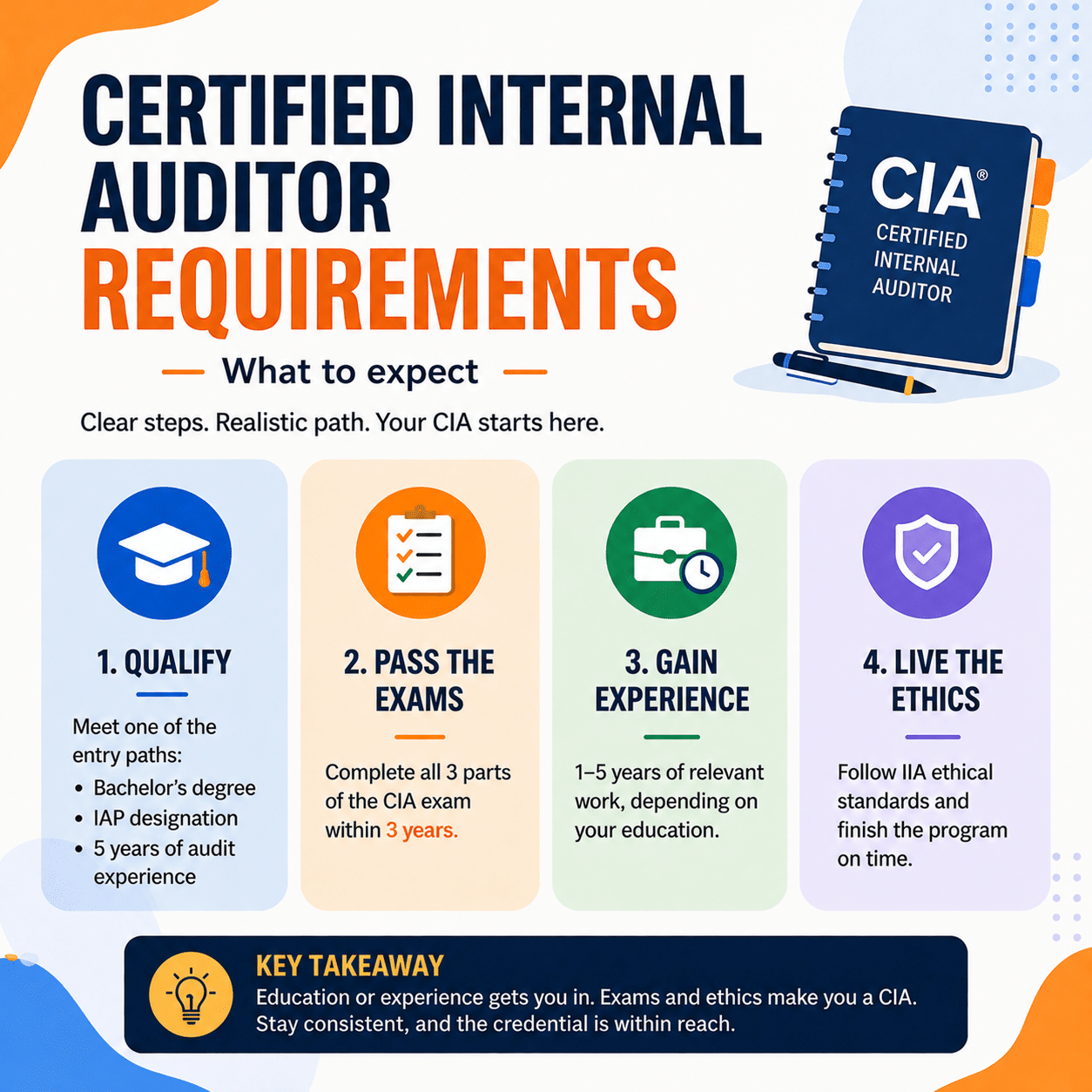
- CIA Requirements: Requirements include qualifying through education or experience, such as having a bachelor’s degree, an IAP designation, or five years of relevant audit experience.
- The CIA Exam: To earn the CIA designation, candidates must pass all three parts of the CIA exam within three years of program entry, with possible extension for a fee.
- Experience varies by Education Level: Length ranges from one year for master’s holders to five years for associate degree holders or equivalent.
- Emphasis on Ethics: Candidates must adhere to strict ethics standards and complete the certification process on time, reflecting the trust and independence required in internal auditing.
- Challenge Pathways: Professionals with certain credentials, including the CPA, CA, or CISA, or extensive experience, can potentially accelerate the CIA certification process.
Who Qualifies For CIA Certification
When people research CIA certification, this is usually the first hurdle: can you even apply?
The good news is that the Institute of Internal Auditors allows more than one way into the program. You don’t need a single perfect background. Instead, candidates can qualify by meeting one of the accepted education-based paths.
In general, you qualify for entry into the CIA program if you have:
- A bachelor’s degree or higher from an accredited university
- An active Internal Audit Practitioner (IAP) designation
- Five years of verified internal audit experience, or equivalent experience if you have a high school diploma or an associate’s degree
I think the CIA’s flexibility is one of the reasons the credential appeals to both recent grads and working professionals. Some people come in through college, sure, but others get there through years on the job.
There’s also a student-friendly option. If you’re in your final year of university or enrolled in an IIA-approved Internal Audit Education Partnership (IAEP) program, you may be allowed to enter the program and even take the exams before graduation. But there’s a catch: you can’t receive certification until you actually graduate.
Documents you’ll usually need
Meeting the education or experience standard is only part of the process. You also need proof. Depending on your path, that may include:
- A degree or official transcripts
- A letter from your university
- A report from an education evaluation service
- Name change documents if your records don’t match your current legal name
- A valid government-issued ID, such as a passport or driver’s license
- A character reference
That last one can surprise people, but it fits the heavy emphasis on ethics in the field. Internal auditors are trusted with sensitive information, so ethics and professional conduct are a big deal from day one.
If you’re doing career research, here’s my advice: check your eligibility before you think about CIA prep courses or exam dates. It saves time and, honestly, it saves stress, too.
What You Need To Complete The CIA Process
Qualifying for the program is step one. Completing it is where the full certified internal auditor requirements really come into focus.
To earn the CIA designation, candidates must finish a few core pieces:
- Pass the exam(s)
- Meet the experience requirement
- Complete the program on time
Let’s break it down.
Pass all 3 exam parts
The CIA exam has three parts. To complete the certification process, you must pass all three within three years of entering the program. In some cases, there’s an option to extend that window by 12 months for a fee.
That timeline is important. Three years may sound generous, but life has a way of getting loud. Work deadlines pile up, family stuff happens, and suddenly six months disappear. I always think it’s smart to plan your exam schedule early instead of assuming you’ll “figure it out later.” Later is sneaky.
Meet the experience requirement
Passing the exam alone isn’t enough. You also need qualifying work experience, and the amount depends on your education level.
Here’s the basic breakdown:
| Education Level | Experience Required |
|---|---|
| Master's degree or higher | 1 year |
| Bachelor's degree | 2 years |
| Associate's degree or equivalent | 5 years |
| IAP holder | Varies, up to 5 years |
In other words, more formal education can reduce the amount of professional experience required. That’s common in professional credentials, and it makes sense. A graduate degree doesn’t replace real-world work, but it can shorten the runway.
Follow ethics and finish the program requirements
Candidates are also expected to follow the profession’s ethics rules and complete the program within the required time frame. This isn’t just a box to check. Internal auditing depends on trust, judgment, and independence. If a profession had a “don’t cut corners” sign taped to the wall, internal audit would probably hang two.
Some professionals may have a faster path
There are also challenge pathways for certain experienced professionals, including people with credentials like:
- CPA
- CA
- CISA
- Or those with 10+ years of experience
These pathways can change how the process works, depending on the candidate’s background.
For aspiring auditors, the biggest takeaway is simple: the CIA isn’t only about passing tests. It’s a full professional qualification. You need the right mix of education, exam success, experience, and ethical standing to finish the process.
Bottom Line
If you’re serious about becoming a certified internal auditor, the requirements are pretty clear once you lay them out.
You need to qualify for entry, pass all three exam parts, meet the experience rules, and complete the process on time.
I’d start by confirming your eligibility first. From there, you can build a realistic plan and move toward the CIA credential with a lot more confidence.
FAQs
To qualify for the CIA program, you must have one of these: a bachelor’s degree or higher from an accredited university, an active Internal Audit Practitioner (IAP) designation, or five years of verified internal audit experience (or equivalent with a high school diploma or associate’s degree).
The CIA exam consists of three parts, all of which must be passed within three years of entering the program. You may extend this deadline by 12 months for an additional fee if needed.
Experience requirements depend on your education: one year for a master’s degree or higher, two years for a bachelor’s degree, five years for an associate’s degree or equivalent, and varying up to five years for IAP holders.
Yes, final-year university students or those enrolled in an IIA-approved Internal Audit Education Partnership program can enter the CIA program and take exams before graduation, but cannot receive certification until they graduate.
Yes, professionals such as CPAs, CAs, CISAs, or individuals with 10+ years of relevant experience may qualify for challenge pathways that can alter the traditional CIA certification process.
A character reference is required to demonstrate ethics and professional conduct, which are crucial in internal auditing because auditors handle sensitive information and must maintain trust and independence.

Kenneth W. Boyd is a former Certified Public Accountant (CPA) and the author of several of the popular "For Dummies" books published by John Wiley & Sons including 'CPA Exam for Dummies' and 'Cost Accounting for Dummies'.
Ken has gained a wealth of business experience through his previous employment as a CPA, Auditor, Tax Preparer and College Professor. Today, Ken continues to use those finely tuned skills to educate students as a professional writer and teacher.