
How Much Do CPAs Make? Salary Ranges + Career Stages
The CPA exam costs a lot, both in terms of time and money.
The exam fees alone usually cost between $1,000 and $2,000—and that’s before adding on the several thousand dollar price tag of a prep course.
All of this is to say: you want to know how much CPAs make, in part, because you want to make sure the ROI is worthwhile.
In this article, I’ll take you through the key factors you need to know: salary, how it shifts from entry level to management level, and ultimately, whether or not the CPA certification is worth it.
Key Takeaways
- More Than Non-CPAs: CPAs typically earn significantly more than non-credentialed accountants, with average salaries around $96,919 compared to $67,905 for accountants.
- Experience and Job Responsibility: They greatly impact CPA salaries, with entry-level CPAs earning $60,000 to $70,000 and senior managers/directors exceeding $160,000.
- Industry and Location Influence Pay: Finance, insurance, and large urban markets often offer higher salaries for CPAs.
- Accounting Salaries Increase with Promotion: Senior audit and tax managers earn up to $180,500 annually.
- The CPA Credential Opens Doors: The CPA unlocks senior roles and higher pay, making the exam process worthwhile for many despite its challenges.
Average CPA Salary: What You Can Expect Nationally And At Different Career Levels
When people search for how much CPAs make, they usually want one clean number. The catch is that no single government source publishes a separate national wage line just for CPAs.
The U.S. Bureau of Labor Statistics groups accountants and auditors together. For that broader occupation, the median annual wage was $81,680. The lowest 10% earned less than $52,780, while the highest 10% earned more than $141,420.
That BLS figure is useful as a baseline, but it doesn’t isolate the CPA credential. For a more direct read on CPA pay, current job-posting data helps. Indeed’s U.S. salary page for Certified Public Accountants shows an average base salary of $96,919, with a low of $58,287 and a high of $161,153, based on 2.2k salaries, last updated March 30, 2026.
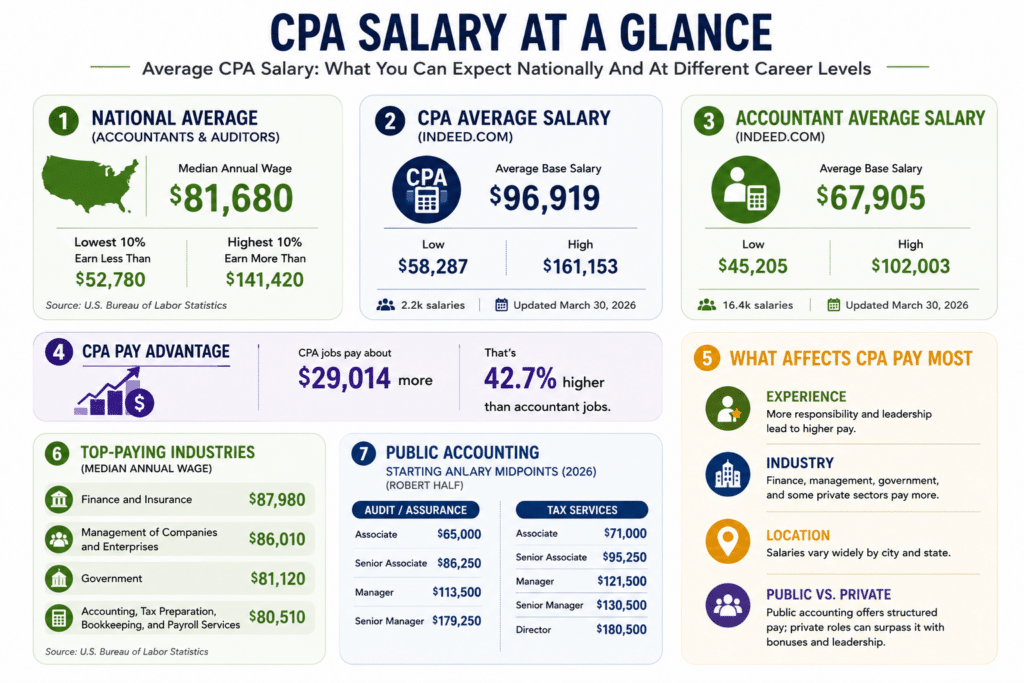
For comparison, Indeed lists the average base salary for Accountants at $67,905, with a low of $45,205 and a high of $102,003, based on 16.4k salaries.
Using those averages, CPA jobs pay about $29,014 more, or roughly 42.7% higher, than accountant jobs. That doesn’t prove a pure credential premium in the same role, but it does show the market pays more for jobs labeled CPA”.
What Affects CPA Pay Most: Experience, Industry, Location, And Public Vs Private Accounting
The biggest driver of CPA salary is usually experience. Not just years worked, but responsibility. Preparing workpapers is one thing: reviewing a team’s work, managing client relationships, signing off on strategy, or owning a department budget is another. Employers pay for judgment.
Industry also matters more than many people expect. On the BLS page for accountants and auditors, the highest-paying major industries were:
- Finance and insurance: $87,980
- Management of companies and enterprises: $86,010
- Government: $81,120
- Accounting, tax preparation, bookkeeping, and payroll services: $80,510
That list is telling. A lot of people assume public accounting automatically pays the most. Early on, public accounting can be attractive because it builds skills and opens doors, but some private-sector and finance roles can catch up to or surpass it, especially when bonuses or leadership responsibilities come into play.
Then there’s the public vs private accounting question. In public accounting, salaries are often more structured by title. Robert Half’s 2026 public accounting salary data shows these midpoint starting salaries:
- Audit/assurance associate: $65,000
- Senior audit/assurance associate: $86,250
- Audit/assurance manager: $113,500
- Senior audit/assurance manager: $179,250
- Tax services associate: $71,000
- Senior tax services associate: $95,250
- Tax services manager: $121,500
- Senior tax services manager: $130,500
- Tax services director: $180,500
Those aren’t tiny jumps. They show why many people stick out the grind in public accounting: the title ladder can materially change earnings.
Robert Half also says salaries for public accounting roles in tax, audit, and assurance are projected to rise 3.7% year over year in 2026, compared with 2.1% across finance and accounting roles overall. That’s a sign of continued demand.
Location still plays a big role. A CPA in New York, Miami, Chicago, Los Angeles, or Seattle will often make more than one in a lower-cost area, though that higher pay doesn’t always make up for the added living expenses. Pay can also vary a lot based on firm size, specialty, and the kind of clients you handle. Someone working in international tax, SEC reporting, or transaction advisory is usually on a different salary path than a CPA in a more general staff role.
Is Becoming A CPA Worth It? Long-Term Earning Potential and Job Outlook
In my view, becoming a CPA is often worth it if you want stronger long-term earning power, broader job options, and better odds of reaching senior roles. Even the BLS notes that completing certification in a specific field of accounting, such as becoming a licensed CPA, may improve job prospects.
That tracks with what employers actually do. Robert Half calls the CPA the gold standard in public accounting and says it is often required or strongly preferred for senior-level roles. That single detail matters a lot. Without the license, you may still build a good accounting career. With it, more doors tend to open.
The salary data support that idea from a few angles:
- Indeed’s CPA average is $96,919 versus $67,905 for accountants
- Becker reports $95,645 for credentialed accountants versus $79,135 for non-credentialed accountants
- Senior public accounting titles can move well into the $130,000 to $180,000+ range
The CPA path comes with real costs. You have exam fees, education requirements, CPA study material, and a big time commitment. It’s not something most people can knock out on the side without making sacrifices. For a lot of candidates, the bigger question isn’t whether the license is valuable. It’s whether they can realistically get through the process while working full-time.
Still, the pay difference is hard to overlook. If you’re deciding whether to stay on a general accounting path or go after the license, it helps to think beyond the first year. The bigger question is what being a CPA can mean for your earnings and career options over the next 10 or 20 years.
Final Verdict
If your goal is to maximize flexibility, move into management faster, or compete for higher-paying tax, audit, and advisory roles, the CPA remains one of the clearest salary boosters in accounting. For many people, that makes the effort worth it.
Bottom line: if you’re wondering how much CPAs make in 2026, a realistic answer is that many salaries land around $80,000 to $100,000+, with lower entry-level ranges and much higher upside as they gain experience, specialize, and move into leadership.
FAQ
On average, CPAs in the US earn around $96,919 per year, according to recent job posting data, which is significantly higher than non-credentialed accountants who average about $67,905 annually.
CPA salaries vary based on experience, industry, location, and whether they work in public or private accounting. Senior roles and specialized fields like tax and audit often earn more.
Entry-level CPAs typically earn $60,000 to $70,000, mid-career CPAs earn $75,000 to $90,000, managers make $95,000 to $120,000, and senior managers or directors can earn $130,000 to $160,000 or more annually.
Public accounting salaries are often structured by title and can increase substantially with promotions. For example, a tax services manager in public accounting may earn around $121,500, with senior managers earning significantly more, reflecting career growth opportunities.
Yes, becoming a CPA generally leads to higher long-term earning power, broader job opportunities, and better chances for senior roles. CPAs can earn notably more than non-credentialed accountants over their careers.
CPAs in large metropolitan areas like New York, Chicago, or Los Angeles typically earn more than those in smaller or lower-cost areas, although higher salaries may not fully offset the increased living expenses in those cities.

Kenneth W. Boyd is a former Certified Public Accountant (CPA) and the author of several of the popular "For Dummies" books published by John Wiley & Sons including 'CPA Exam for Dummies' and 'Cost Accounting for Dummies'.
Ken has gained a wealth of business experience through his previous employment as a CPA, Auditor, Tax Preparer and College Professor. Today, Ken continues to use those finely tuned skills to educate students as a professional writer and teacher.