
How To Study For The CFA® Exam: 3-Step Prep Plan
The CFA® exams have a reputation for being tough, and that reputation is earned.
But passing isn’t about studying harder every single day.
It’s about studying with a plan.
As an exam prep expert, I spend a lot of time researching educational psychology, exam prep courses, and firsthand student experiences.
In this guide, I’ll unveil the three steps candidates should follow to study for the CFA® exam—the right way—and maximize their chances of success.
Key Takeaways
- Get Real: Create a CFA® study plan that matches your exam level, timeline, and weekly availability to set realistic expectations, aiming for around 300 total study hours for Level I over 4 to 6 months.
- Top Testing Strategies: Prioritize high-weight topics and difficult areas, use active recall techniques, and incorporate timed practice questions to enhance retention and simulate exam conditions.
- Build Your Timeline Strategically: Start with a broad curriculum overview, then deepen understanding and practice in the middle months, and focus on review and mock exams in the final months.
- Realistic Practice is Key: Use full-length, timed mock exams in the last few weeks to build stamina, identify weak spots, and experience exam conditions to reduce test-day anxiety.
- Self-Care Isn’t Selfish: It’s a must. Manage burnout by taking breaks, getting enough sleep, and avoiding last-minute cramming to ensure you are alert and confident on exam day.
Build A CFA® Study Plan Around Your Exam Level, Timeline, And Weekly Hours
The first step is simple: make your study plan fit your real life.
A lot of candidates fail before they even begin because they copy someone else’s schedule. While I’d love to be able to give you something pre-built, it won’t account for any of the factors that make a schedule successful: your specific learning style, motivators, existing knowledge, study speed, and so much more.
Think of it this way: a Level I candidate working full-time needs a different plan than someone studying for Level II with a lighter work schedule. If you want to know how to study for the CFA exam in a way that actually sticks, start with your exam level, your timeline, and the hours you can realistically give each week.
For many candidates, a common benchmark is about 300 study hours per level. That doesn’t mean you need to obsess over the exact number, but it does give you a useful target. Many candidates also benefit from starting 4 to 6 months before the exam rather than trying to squeeze everything into a short sprint.
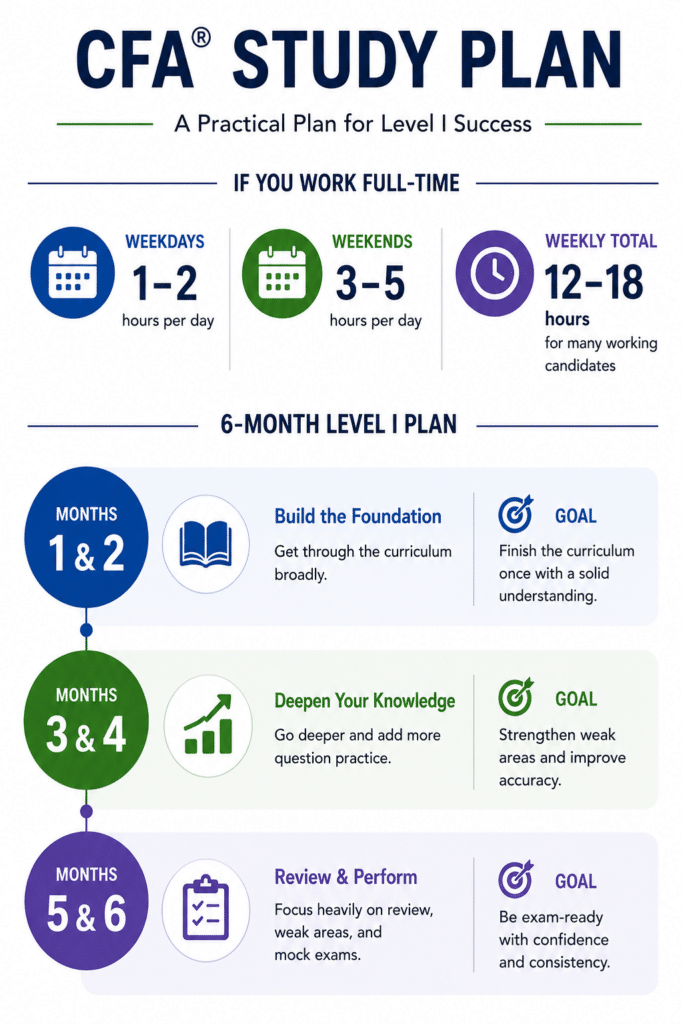
Here’s a practical way to think about it if you work full-time:
- Weekdays: 1 to 2 hours per day
- Weekends: Longer blocks, often 3 to 5 hours
- Weekly total: Usually 12 to 18 hours for many working candidates
If I were building a basic 6-month Level I plan, I’d break it up like this:
- Months 1 and 2: Get through the curriculum broadly
- Months 3 and 4: Go deeper and add more question practice
- Months 5 and 6: Focus heavily on review, weak areas, and mock exams
That kind of structure matters because the CFA curriculum is wide. It’s easy to spend too much time polishing one topic while ignoring three others. A calendar keeps you honest.
I also think it helps to choose your core study tools early, selecting a CFA® prep course that works with your study style:
➡️ If you learn best by doing tons of practice questions, go with UWorld. It’s especially useful for candidates who want to improve by working through problems and reviewing the explanations.
➡️ If you want something more affordable and don’t need a lot of hand-holding, AnalystPrep is a good match for self-directed study.
➡️ If you prefer a more structured, traditional prep course, Kaplan Schweser makes the most sense for candidates who want a clearer study plan and more guided materials.
One more thing: build in buffer time. Life will interrupt you. Work gets busy. You get sick. A family event pops up. If your plan is packed too tightly, one bad week can wreck the whole thing. I’d rather see a slightly slower schedule you can actually follow than a perfect-looking plan that falls apart by week three (the latter is more common than you might think).
Study The Right Way With Topic Prioritization
Once your schedule is in place, the next question is how to use your study hours well.
This is where many candidates waste time. Reading page after page can feel productive, but it often isn’t. It’s like watching cooking videos and expecting to become a chef. You might learn something, sure, but you won’t really know what you can do until you get in the kitchen.
For the CFA exam, I’d focus on three things: topic prioritization, active recall, and timed practice.
Start with topic prioritization
Not every topic carries the same weight. Some areas matter more, and certain topics, like Ethics, stay especially important across levels. That means your study plan should reflect exam weight and difficulty.
A simple approach:
- Spend more time on high-weight topics
- Give extra attention to topics you personally find difficult
- Don’t aim for perfection in every reading before moving on
That last point matters. I’ve seen candidates get stuck trying to “master” one chapter while the calendar keeps moving. Progress beats perfection.
Use active recall instead of passive review
If you read a section and then immediately close the book and quiz yourself, that’s active recall. And it works much better than just rereading highlighted lines until your eyes glaze over.
Try this after each study session:
- Write down key formulas or ideas from memory
- Ask yourself what the topic is really testing
- Answer a few questions without looking at your notes first
- Explain the concept in plain English, like you’re teaching a friend
I like this method because it exposes weak spots fast. It’s uncomfortable, yes. But that discomfort is useful. It tells you where your memory is thin.
A helpful study flow is Prepare > Practice > Perform:
- Prepare: Read and learn the concept
- Practice: Answer targeted questions on that topic
- Perform: Revisit it later in mixed sets to build retention under pressure
Make practice a major part of your prep
A strong CFA study strategy usually gives a huge role to practice questions. I’d suggest spending roughly half of your total study time doing questions and reviewing the explanations.
Start with topic-specific questions. Later, mix topics together. And time yourself. For Level I, a useful pace is about 90 seconds per question. Levels II and III have different timing and question formats, so pacing should be adjusted accordingly.
Most important of all, review the rationales:
- Why was the right answer right?
- Why was your choice wrong?
- Did you miss the concept, the wording, or the time pressure?
As you get deeper into your studies, you’ll start to realize that your mistakes have nothing to do with knowledge. You’ll miss a keyword, you’ll choose a response without thoroughly reading the question, or your brain will switch two options around.
If you can find the root of your mistakes, the solution will be that much clearer.
Finish Strong In The Final Weeks By Using Mock Exams, Reviewing Mistakes, and Managing Burnout
The last 2 to 3 weeks before the exam can make a big difference.
At this point, I wouldn’t spend much time trying to relearn the entire curriculum from scratch. The better move is to shift heavily into exam-mode practice. A common recommendation is to spend about 90% of this final stretch on practice and review.
Use full-length mock exams the right way
If possible, take at least three full-length mock exams under timed conditions. That means sitting down and treating it like the real thing, not pausing every ten minutes to check your phone or grab a snack. Painful? A little. Useful? Absolutely.
Mocks help you:
- Build stamina
- Spot timing issues
- Find weak topic areas
- Get used to exam pressure before test day
The CFA exam format includes timed sessions, so practicing in blocks matters.
Review mistakes deeply
After each mock, the real work begins.
Don’t just look at your score and move on. Dig into the misses. I’d ask:
- Did I misread the question?
- Was I shaky on the concept?
- Did I rush?
- Am I seeing a pattern in one topic area?
Keep a short error log. Nothing fancy. Just track repeated mistakes, formulas you forget, and concepts that still feel slippery. That gives you a much clearer final review plan than random guessing.
And yes, make time to refresh Ethics. It’s one of those topics that deserves another pass in the home stretch.
Manage burnout so you don’t peak too early
This part gets ignored, but it shouldn’t. Burnout can wreck good preparation. If you’ve been studying for months, your brain may start pushing back. Hard.
A few things help:
- Keep sessions shorter if focus drops
- Take walks or quick breaks between blocks
- Sleep enough instead of trying to win with all-nighters
- Stop cramming the night before the exam
- Ask “why” when reviewing concepts, so they stick better
I know the temptation is to study every waking minute in the final days. But that usually backfires. You want to arrive alert, not fried.
Track your progress, tighten up weak areas, and trust the work you’ve already done. At the end, passing the CFA exam is less about one heroic week and more about months of smart, steady reps.
Final Thoughts
If you’re asking how to study for the CFA exam, the answer isn’t easy, but it is simple: plan realistically, practice deliberately, and finish with focused mocks and review. Build a schedule that fits your life, prioritize high-weight and personally difficult topics, use active-recall methods and timed practice questions, and limit yourself to a few high-quality resources.
Above all else?
Trust the process. Small, consistent reps with smart practice beat frantic cramming every time. Start your plan today, stick to it, and you’ll walk into exam day prepared and confident.
FAQ
Most Level I candidates benefit from around 300 total study hours, spread over 4 to 6 months, combining regular weekday and longer weekend study sessions to build a realistic and effective schedule.
Create a study plan based on your CFA exam level, timeline, and weekly available hours. For example, a 6-month Level I plan could cover broad curriculum review in months 1-2, deeper study with practice questions in months 3-4, and focused review plus mock exams in months 5-6.
Active recall involves quizzing yourself immediately after studying a topic—writing down key formulas, explaining concepts in your own words, and answering questions without notes to identify weak areas and improve retention beyond passive reading.
Taking at least three full-length timed mock exams helps build exam stamina, spot timing and knowledge gaps, get familiar with exam pressure, and identify areas to review, especially in the final 2-3 weeks before test day.
Prioritize high-weight topics according to the CFA exam level, with extra focus on challenging areas and ethics, which remain important across all levels. This ensures efficient use of study time by concentrating on exam-relevant content.
Avoid burnout by keeping study sessions shorter if focus wanes, taking breaks, getting enough sleep, avoiding last-minute cramming, and engaging with the material by asking ‘why’ to deepen understanding.

Kenneth W. Boyd is a former Certified Public Accountant (CPA) and the author of several of the popular "For Dummies" books published by John Wiley & Sons including 'CPA Exam for Dummies' and 'Cost Accounting for Dummies'.
Ken has gained a wealth of business experience through his previous employment as a CPA, Auditor, Tax Preparer and College Professor. Today, Ken continues to use those finely tuned skills to educate students as a professional writer and teacher.


