
CPA Exam Changes: Is The Updated Test Harder Now?
CPA exam + easy. With pass rates as low as 41.3% in Q1 of 2026, those words don’t really belong in the same sentence.
Due to political, global, and national influences, tax rules are constantly changing—and it can be hard to stay up to date.
And the CPA exam evolves alongside those real-world shifts.
But staying up to date doesn’t have to be impossible. Here are the latest CPA exam changes you need to know if you’re studying for the exams, covering everything from sections to common mistakes.

Key Takeaways
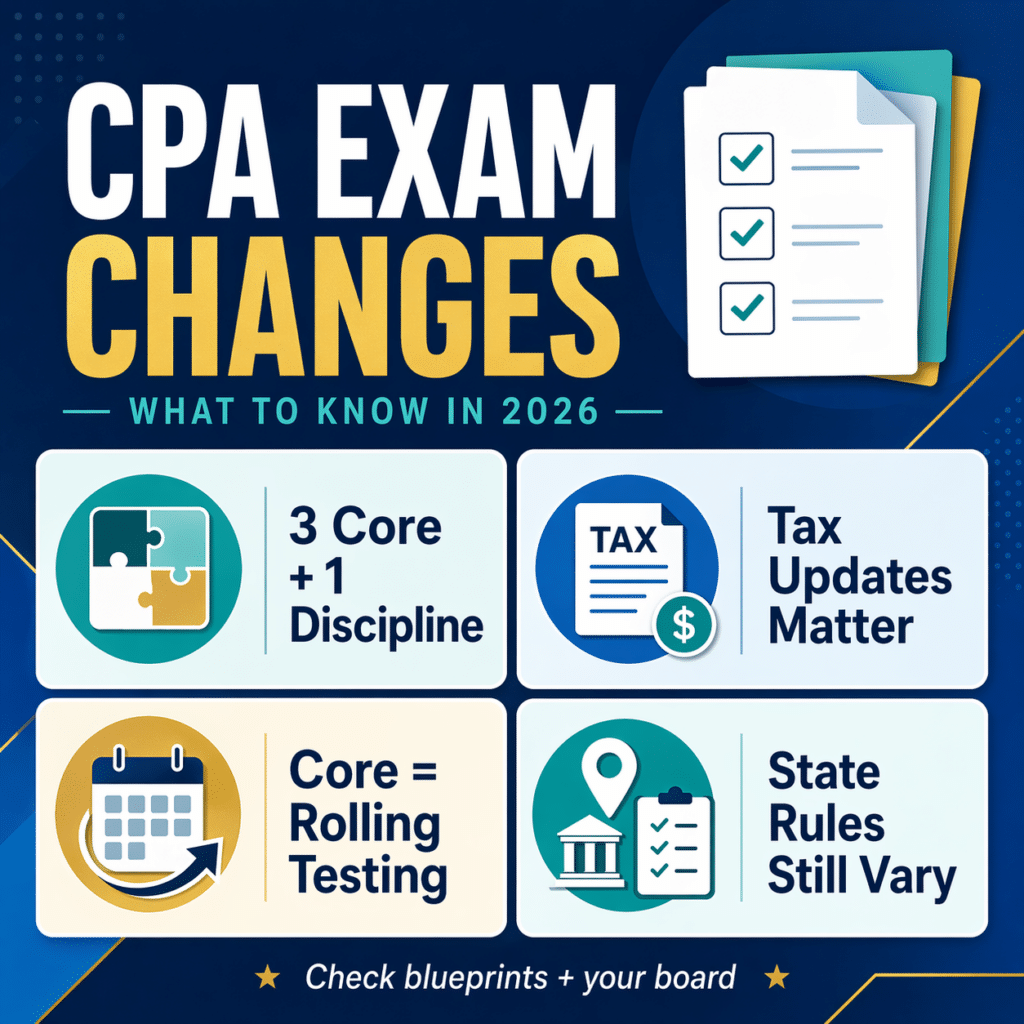
- Same Four-Part Framework: The CPA Exam still has four sections total: three Core sections, plus one Discipline section of your choice.
- Tax Timing Could Matter: If you’re planning around REG or TCP, keep an eye on tax-law updates and the latest blueprints.
- Two Different Testing Calendars: Core sections run on a rolling schedule throughout the year, but Discipline sections are only administered in the first month of each quarter.
- Your State Still Sets the Rules: Even though the exam itself is standardized, credit windows and licensing details can still vary by jurisdiction.
- Discipline Choice Is Personal: Choose the Discipline section that best matches your background, strengths, and schedule.
What Changed On The CPA Exam And Why It Matters
The CPA exam itself hasn’t gotten another structural overhaul since 2024. Candidates still take four sections, each four hours long. What has changed is the practical landscape around the exam: tested tax content is shifting, score timing is different depending on section type, and credit-window rules are more generous in many jurisdictions.
Why does that matter? Because passing isn’t only about accounting knowledge. It’s also about strategy. If you don’t know when a Discipline section is offered, when scores come back, or whether your state adopted the longer credit window, you can build a study plan that looks smart on paper and still backfires.
How The Core-Plus-Discipline CPA Exam Structure Works Now
The current structure is still the CPA Evolution format, as it was rolled out in January 2024. I’d think of it as three required Core sections plus one chosen Discipline.
The Core sections are:
- AUD
- FAR
- REG
Then you choose one Discipline:
- BAR
- ISC
- TCP
Importantly, your Discipline does not change, differentiate, or limit your license. Passing TCP doesn’t make you a tax-only CPA, and choosing ISC doesn’t lock you into IT. You earn the same CPA license either way.
Question formats also remain familiar: multiple-choice questions and task-based simulations across all sections, based on the AICPA’s CPA Exam Blueprints.
What Is Changing: AUD, FAR, REG, And The Discipline Sections
The most meaningful recent content changes are tied to tax. New federal tax law changes are expected to become testable starting July 1, 2026, which mainly affects REG and TCP. So if you’re taking either section in the second half of the year, I’d expect updated rules, deductions, and planning issues to matter more.
AUD and FAR are more stable, though blueprint updates can still shift emphasis. FAR candidates should always watch for technical accounting areas that move in or out of focus. BAR and ISC tend to see narrower updates than REG or TCP.
Bottom line: the official Blueprints, updated once or twice a year, are still the source that matters most.
Key CPA Exam Dates, Score Release Timing, and Transition Rules To Watch
For AUD, FAR, and REG, continuous testing remains in place, which gives candidates much more flexibility. The Discipline sections are different: they’re still offered only in the first month of each quarter.
If you sit for a Discipline, target score releases are:
- January testing: March 13
- April testing: June 16
- July testing: September 11
- October testing: December 15
Core section scores are released on a rolling basis throughout the year.
The credit window is another big watch item. NASBA moved its model rule from 18 months to 30 months, tied to the score release date, but adoption is still state-by-state. Some candidates may effectively have even longer.
How These Updates Affect Your Study Plan And Section Order
If I were planning from scratch, I’d build around logistics first, not just difficulty. Core sections are easier to schedule because they test year-round. Discipline sections require tighter timing, so missing a window can push your whole plan back.
For many candidates, that means taking AUD, FAR, or REG first, then fitting the Discipline into an open quarter. If you’re leaning toward REG or TCP, I’d pay close attention to whether you want to test before or after the tax-law changes become testable.
And don’t ignore your state board. Eligibility, application rules, and any adoption of longer credit windows still depend on jurisdiction, not national headlines.
Common Mistakes Candidates Make When the CPA Exam Changes Roll Out
The first mistake is assuming every “CPA exam changes” article applies equally in every state. It doesn’t. State boards still control eligibility and many licensing details.
The second is confusing exam structure with licensure rules. The exam changed under CPA Evolution, but education requirements were not automatically rewritten everywhere.
Third: using old prep materials or outdated CPA review courses for too long. If the Blueprints update, stale tax content can hurt you fast.
Finally, some candidates overthink the Discipline choice. Pick the section that best matches your strengths, study materials, and timeline, not the one with the loudest internet opinions.
Conclusion
The biggest CPA exam changes are really about content timing, score release schedules, and state-specific rules, not a brand-new format.
I’d verify your board’s policies, check the latest Blueprints, and build your study order around the calendar. That’s where smart candidates gain an edge.
Now get started with studying with one of the top CPA review courses that works for you.
FAQ
The CPA exam format remains the same, but major tax law updates from the One Big Beautiful Bill Act (OBBBA) become testable on July 1, affecting the REG and TCP sections. Score release timing and credit window rules vary by state, impacting exam strategy.
The CPA Evolution format includes three required Core sections—AUD, FAR, and REG—plus one chosen Discipline section from BAR, ISC, or TCP. Passing any Discipline earns the same CPA license without limiting your career path.
Core sections (AUD, FAR, REG) have continuous monthly testing with rolling score releases year-round. Discipline sections offer quarterly testing windows with fixed score release dates, requiring careful planning to avoid delays.
Each state controls licensure rules like credit hour requirements and credit window lengths. While the exam changed nationally, state adoption varies, so verifying your board’s policies is essential for eligibility and study planning.
Focus on scheduling Core sections first due to flexible testing. Always use the latest AICPA Blueprints and prep materials reflecting updated tax laws and exam content shifts.

Kenneth W. Boyd is a former Certified Public Accountant (CPA) and the author of several of the popular "For Dummies" books published by John Wiley & Sons including 'CPA Exam for Dummies' and 'Cost Accounting for Dummies'.
Ken has gained a wealth of business experience through his previous employment as a CPA, Auditor, Tax Preparer and College Professor. Today, Ken continues to use those finely tuned skills to educate students as a professional writer and teacher.