

In 2026, the CFP® exam had more candidates take the test than ever.
And for good reason, too. According to the BLS, the personal financial advisor career is growing at more than double the average rate.
But let’s be clear: the CFP® exam? It’s no joke.
Kaplan CFP® Review is a prep course designed to help students prepare—in fact, their College for Financial Planning was the originator of the CFP® mark.
But do their study materials hold up? I took the course myself to find out.
Is Kaplan CFP® the Best Prep Pick?
- Great for Clear Lessons: Kaplan is a strong choice if you want a CFP® course with organized, note-friendly lessons.
- Strong Practice Experience: Kaplan does a good job with realistic practice questions, which can help you feel more prepared.
- Nice Extra Study Tools: The downloadable podcasts are a helpful bonus if you want support outside the main dashboard.
- More Calm Than High-Energy: If you prefer very animated instructors, Kaplan may feel a little more straightforward than exciting.
- Big Assessment Up Front: Kaplan’s 100-question pre-study assessment can feel a little time-intensive at the beginning.
Kaplan CFP® Review Course Overview

You’d expect Kaplan to be a good prep course when they acquired the company that originally created the CFP®, but I was a little nervous at first.
One thing about me? I’m the epitome of a modern learner. Give me short and sweet, fast navigation, quick lessons, plenty of breaks, and something I can use on the go.
I was honestly pretty shocked to find that Kaplan ticked off most of those boxes.
20-minute video lectures, one of the speediest user interfaces I’ve encountered, a variety of study materials to keep studying from becoming too stale, a mobile-friendly platform, podcasts I could download to my phone—even adaptive learning technology and detailed performance tracking.
So yes, the company itself is older, and the content is nothing flashy or high-energy—but for reliability and efficiency? Kaplan has a lot going for it, even if the presentation is more austere.
Let’s take a closer look at how those features actually perform.
Pros
✅ Very clean slides for note-taking
✅ Realistic CFP-style practice questions
✅ Fast, simple platform navigation
✅ Helpful performance tracking to monitor progress and improvement
✅ Slower lecture pace gives time to absorb the material
Cons
❌ Video lessons aren’t especially exciting
❌ Answer explanations could use more depth
❌ Audio quality could be sharper in some lessons
Kaplan CFP Review Package Options
Kaplan Essential Package
The Essential package includes Kaplan’s core CFP review tools: textbook PDFs, financial calculator videos, a calculator workbook, the pre-study assessment, Review QBank, study checklists, Activity Feed, Performance Tracker, and InstructorLink email access.
This is the better fit if you’re comfortable studying on your own and mainly want Kaplan’s structure, practice questions, and progress tracking without adding review classes.
Kaplan Premium Package
The Premium package includes everything in Essential, then adds review classes, the video library, CFP exam podcasts, commonly tested topic summaries, financial planning case studies, a mock exam, and PassProtection.

This is the stronger option if you want a fuller review experience before exam day. The class formats, podcasts, mock exam, and extra case-based practice make it feel more complete than a basic self-study package.
| Feature | Essential | Premium |
|---|---|---|
| Price | $599 | $1,399 |
| Best For | Independent study | More guided review |
| Core Study Tools | Textbook PDFs, calculator videos, QBank, checklists, Activity Feed, Performance Tracker, InstructorLink | Everything in Essential |
| Class Access | ❌ | Live Online, On-Demand, or Onsite options |
| Extra Review Tools | ❌ | Video library, podcasts, topic summaries, case studies, mock exam |
| PassProtection | ❌ | ✅ |
How Kaplan’s CFP Lessons Are Organized
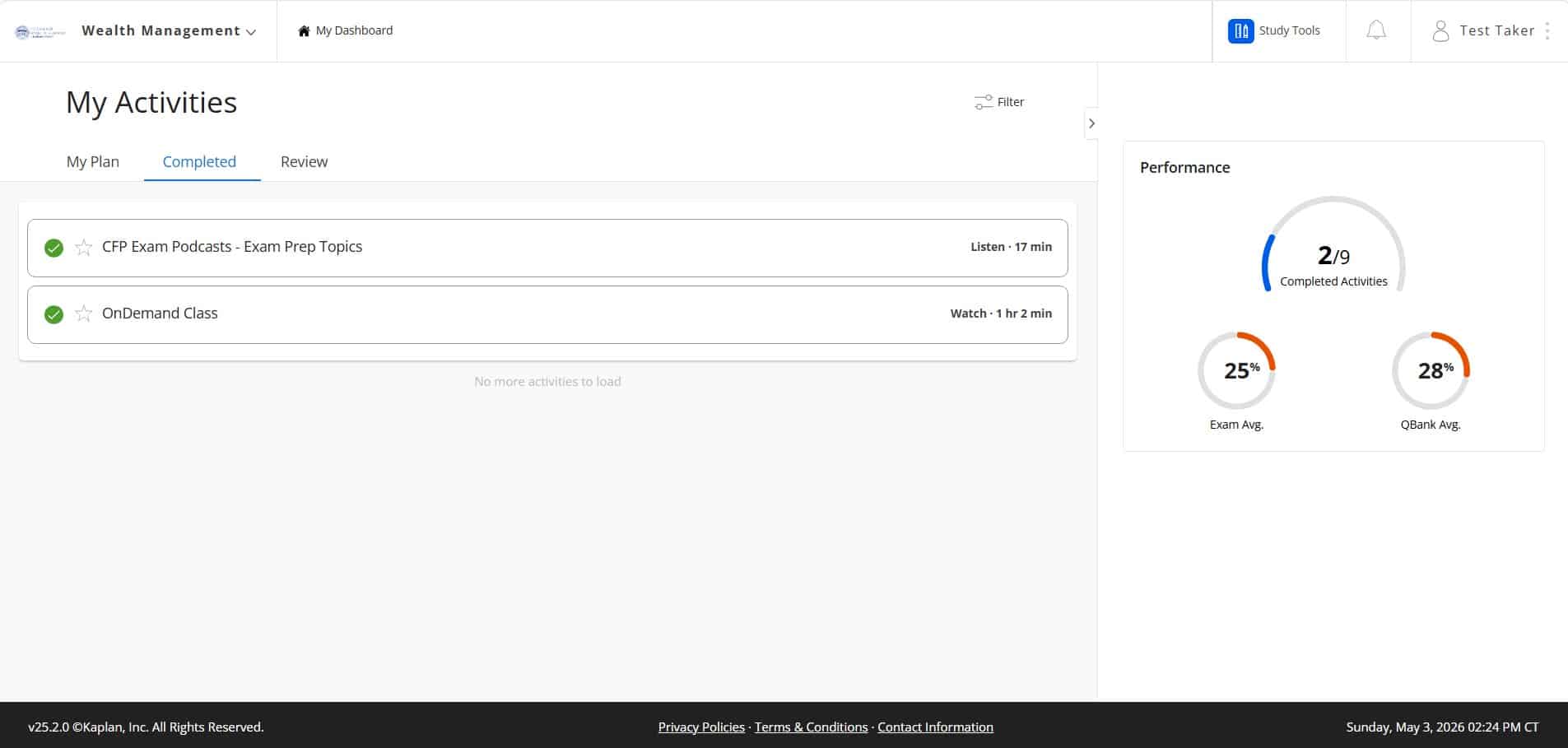
Kaplan’s CFP review course felt very straightforward. The lessons I reviewed usually ran around 20 to 30 minutes, which is longer than the super-short videos I’ve seen in some exam prep courses but still manageable.
The pace was one of the things I liked most. The instructor wasn’t especially animated, but he spoke clearly and gave me enough room to take notes while the lesson was happening. I’ve used courses where the instructor is more entertaining but moves so quickly that I’m constantly pausing, rewinding, or trying to catch up. Kaplan didn’t feel like that.
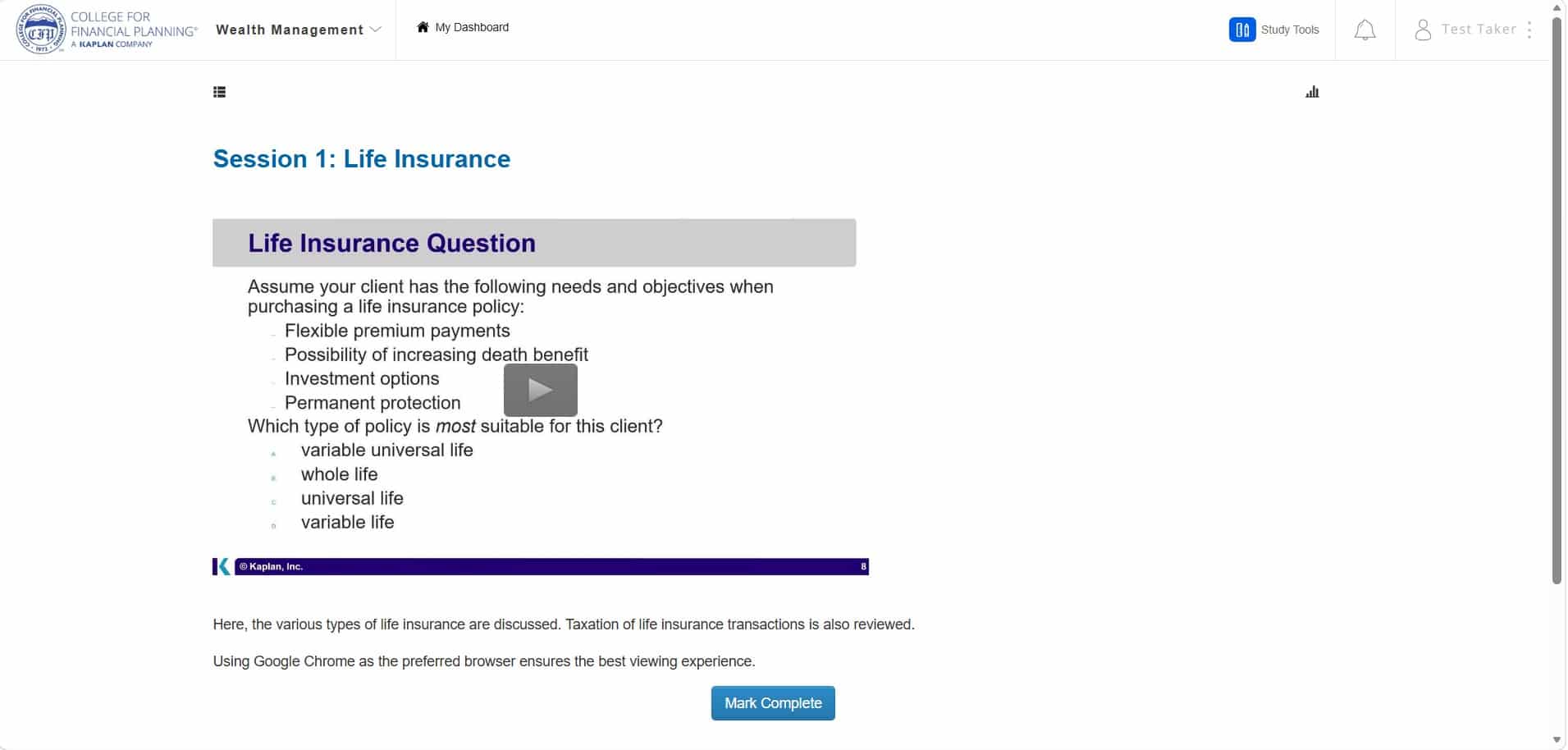
The slides were also exceptionally clean. They weren’t crammed with text, and they worked well as a note-taking companion. I didn’t feel like I was fighting the slide deck just to figure out what mattered.
Kaplan’s Premium package includes a video library, study checklists, commonly tested topic summaries, financial planning case studies, a Review QBank, and a mock exam. The QBank includes about 2,500 exam-like questions that can be filtered by subject area or used to create custom quizzes.
Kaplan InstructorLink and Access Windows in Real Use
Kaplan includes InstructorLink email access in both Essential and Premium, which lets students contact expert faculty from the learning platform.
That fits the course style well. Kaplan didn’t feel like a course built around constant hand-holding, but it did feel structured enough that I wouldn’t expect to need support for every little thing. The platform layout, Activity Feed, and Performance Tracker did a lot of the organizing work on their own.
Kaplan’s online assets for CFP exam prep generally expire at the end of the month of the selected exam window, while the Review QBank expires 12 months from first access.
Practice Questions and Explanations
The practice questions were one of the strongest parts of Kaplan CFP Review for me. They felt extremely similar to the style of questions I saw in the CFP Board’s sample exam materials, which made the course feel practical instead of theoretical.
I also liked that the questions didn’t feel watered down. They made me apply the material in a way that felt aligned with the actual exam, especially when scenarios required more than basic memorization.
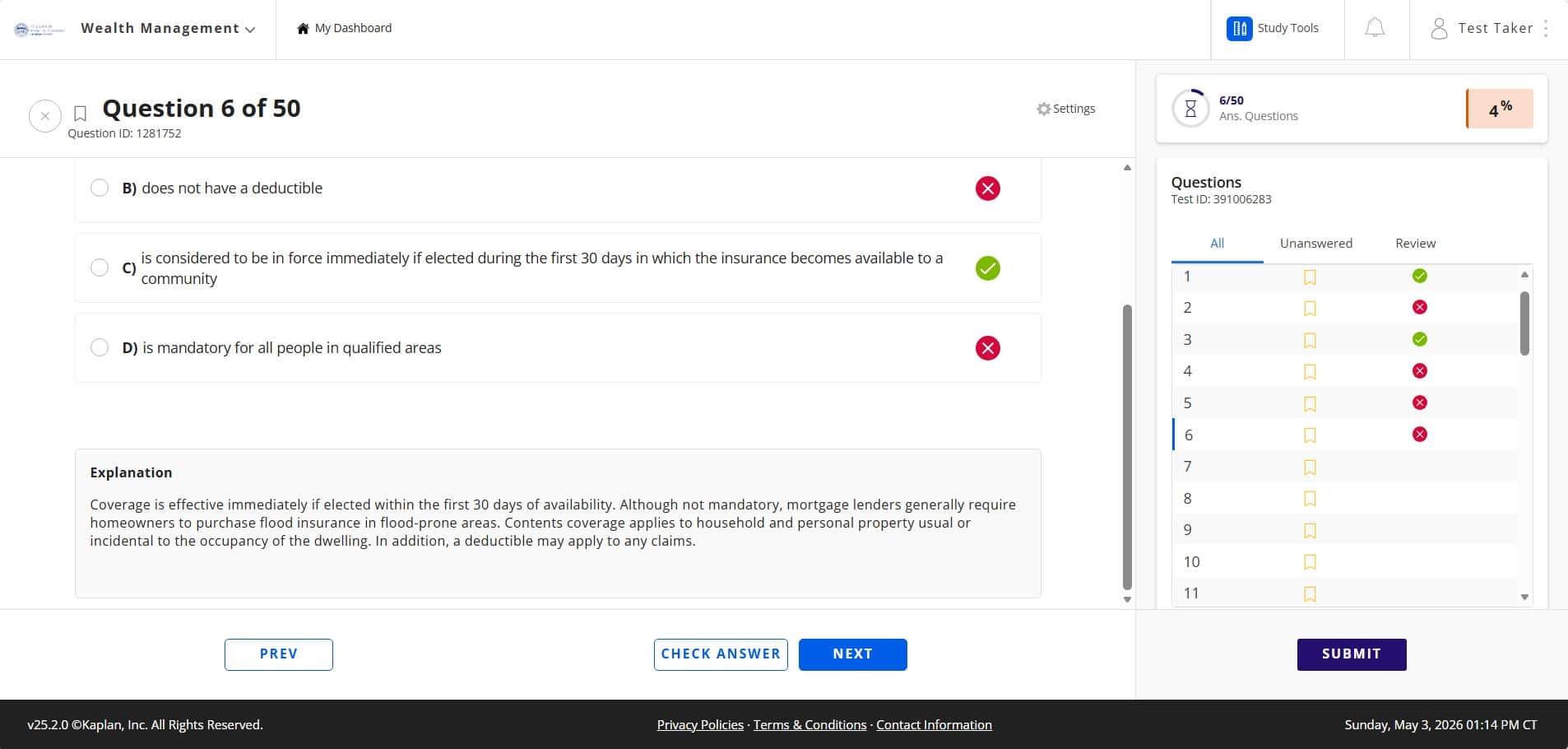
The explanations were more concise than I personally prefer. I would’ve liked more detail in some places, and a few visuals or charts would’ve made certain explanations easier to absorb. That said, I can see why some students would like Kaplan’s style. The explanations usually got straight to the point: no, this answer isn’t right, and here’s the specific reason.
That can be helpful if long rationales tend to slow you down or make review sessions feel cluttered.
What 20-Minute Kaplan Videos Felt Like to Watch
Kaplan’s video lessons weren’t the most entertaining I’ve used, but they made sense from a learning perspective. The instructor’s slower pace gave me time to process the material, and the slides made it easy to follow along.
The dashboard was better than I expected. It loaded quickly, the navigation was simple, and the course made it obvious what I needed to do next. I liked that I could log in and immediately see the work in front of me instead of clicking through a maze of menus.
The audio was the one technical piece I would soften but still mention. In a few places, it sounded a little less crisp than I expected from a major education company. It wasn’t a major issue, and it didn’t stop me from learning the material, but I did notice it because the rest of the course felt so strong.
Diagnostic Assessment and Performance Tracking
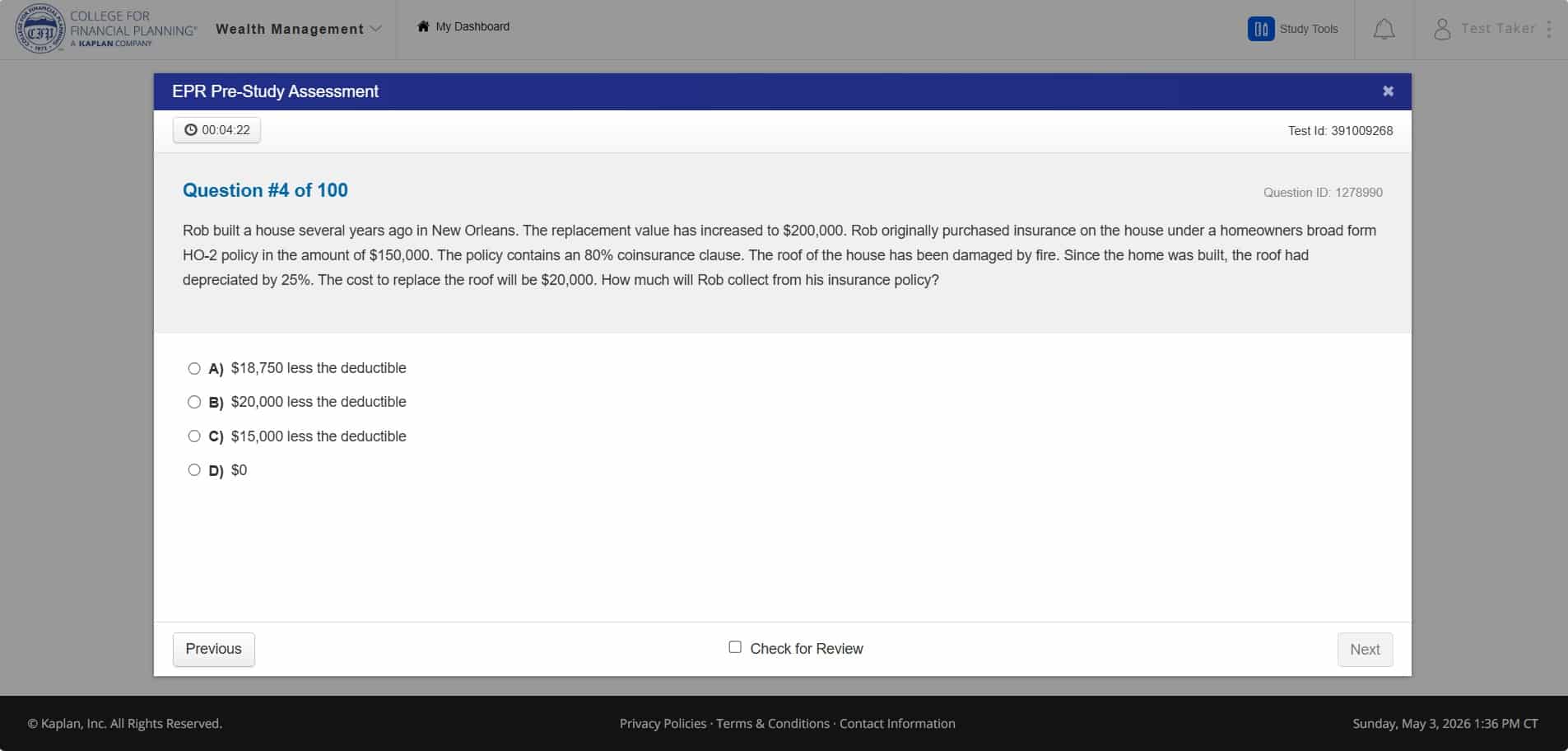
Kaplan’s 100-question pre-study assessment is a big upfront task, but I think it’s worth doing. The assessment helps the platform identify stronger and weaker areas early, which can make the rest of the study process more efficient. Kaplan says the pre-study assessment is designed to gauge overall readiness and highlight challenging areas from the start.
I wouldn’t start it casually, though. I’d carve out enough time to finish it properly because 100 questions is a lot. It can save time later, but it’s definitely not a quick warmup.
The performance tracking feature was another highlight. I liked being able to see my overall average accuracy, how much of the available question bank I had worked through, and how my performance looked by module. The module-level breakdown made the data feel more useful because I could see total questions, answered questions, time spent, and score percentage for each area.
Kaplan describes its Performance Tracker as a tool that shows progress across study activities and topic areas, which matched how I used it inside the course.
Where Kaplan Earned Its Price (and Where It Didn’t)
Kaplan’s value comes from how balanced the course feels. The platform is simple, the questions feel realistic, the slides are easy to learn from, and the tracking tools make progress easier to understand.
I wouldn’t describe Kaplan as the most exciting CFP review course, but I also don’t think excitement is always the goal. For me, the course worked because it made the material easier to sit with. The slower videos, clean slides, practical questions, and straightforward dashboard created a calmer study experience than I expected.
Premium adds more value for students interested in review classes, a mock exam, podcasts, case studies, and the PassProtection guarantee. Kaplan says eligible Premium students who don’t pass can choose either a refund of the Premium EPR tuition cost or complimentary enrollment in another Premium EPR within one year.
For other top picks, check out our roundup of the best CFP review courses.
Bottom Line
Kaplan CFP Review worked for me because it gave me room to actually learn. The lessons weren’t overly hyped, but the slower pace, clean slides, and straightforward explanations made the material easier to absorb. I liked the realistic practice questions, the fast platform, the performance tracker, and the podcasts as a way to break up study sessions.
I’d choose Kaplan if I wanted a structured, polished CFP review course that feels serious without being overwhelming.
FAQs
Yes. Kaplan is worth considering if I wanted a structured CFP review course with clean lessons, realistic practice questions, and useful performance tracking.
Kaplan offers Essential and Premium CFP exam prep packages. Essential is the self-study option, while Premium adds review classes, a video library, podcasts, a mock exam, and PassProtection.
Yes. The videos weren’t especially exciting, but they were clear, steady, and easy to take notes from.
Kaplan’s Review QBank includes about 2,500 exam-like questions.
Kaplan is best for students who want a structured course with clean slides, realistic practice, simple navigation, and performance tracking that makes progress easier to measure.