
Everyone planning to sit for the CFA® exam already knows how overwhelming it can feel.
And the wrong prep course? It can make things a lot worse.
According to the CFA Institute, most candidates spend 300+ study hours per exam level, so you want to spend some dedicated time considering your prep course options.
In this UWorld CFA® Review, I’m here to help.
I’ll share what it’s like to use UWorld, who it works best for, and how it stacks up against the top CFA® prep courses so you can decide if it fits your study style.
Quick Take: Who Is the UWorld CFA® Review Course Best For?
- If you learn best by practicing tough questions, it’s likely that UWorld’s practice-centric approach will work well for you.
- If you’re after a study plan that monitors your progress and study time, UWorld’s performance tools will help you stay ‘locked in’.
- If you enjoy studying on a smartphone, tablet, or laptop, you’ll appreciate UWorld’s cross-device compatibility.
- If you’d rather have a lot of live classes every week, then UWorld might not be what you’re looking for.
- If extensive person-to-person support and tutoring matter to you, UWorld’s self-study courses may not give you the level of coaching you need.
UWorld CFA® Overview

While checking the course out for my UWorld CFA® review, I couldn’t help but notice how simple and clean the platform was.
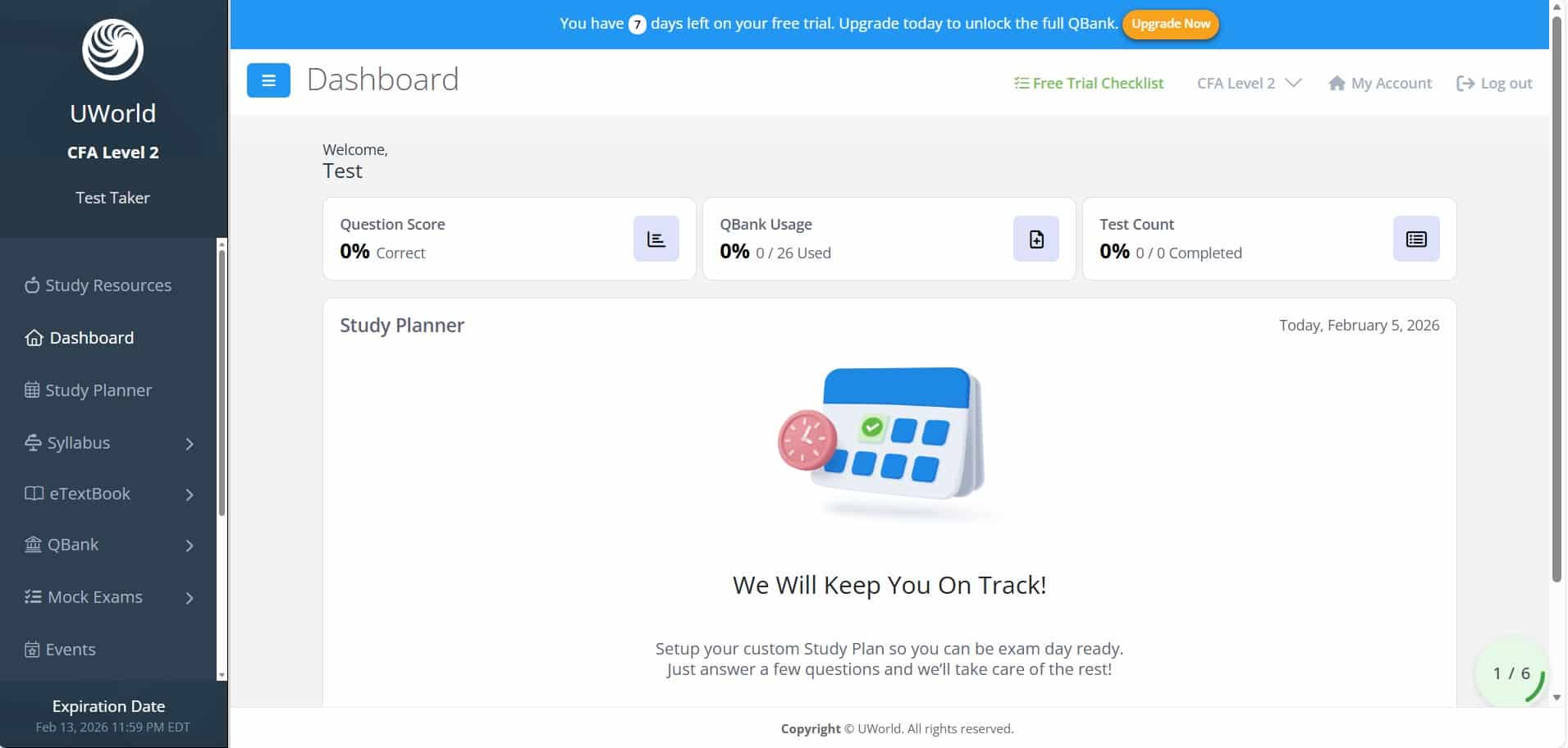
The first thing I saw each time I logged into the dashboard was my accuracy percentage, QBank usage, and the number of tests I’d taken, all positioned over the study planner. After taking a few quizzes, the system began to highlight my weaker areas, making it easier to adjust my study plan rather than guessing what to study next. My average score started at around 68%, and in just a few weeks, it jumped into the mid-70s.
The course is self-paced as well, meaning you can study whenever you want—the materials are always available, with no live sessions. If your day-to-day lifestyle is pretty packed, UWorld’s self-study format gives you added flexibility you wouldn’t get with a course built around a live class schedule.
Pros
-
The answer explanations are some of the best I’ve seen -
The question bank feels very similar to the real test -
The study plan and progress tracker help you stay on schedule -
The platform works great on tablet, laptop, or phone -
UWorld’s exam-quality mock exams help you prepare for the real experience
Cons
-
The course is mostly self-study, so you need to be disciplined -
You have to buy one level at a time
UWorld CFA Package Options
UWorld makes three CFA course packages available for students: Core, Advanced, and Elite. When I compared the packages, the major difference was in how many mock exams, videos, and support features you get.
Core
To me, the Core package is more suitable for students who already understand most of the material and want to focus on MCQ practice.
Core includes:
- Full question bank (QBank) access
- 2,800+ practice questions
- Performance tracking and score reports
- Digital textbooks
- Study tools and progress dashboard
- Course access for a set period.
Advanced
In my opinion, this is the package most students should consider. It comes with videos and mock exams, and I find these two very important for passing the Chartered Financial Analyst exam. Of course, that doesn’t mean it’s impossible to pass without them, either.
Advanced has everything already included in Core, with the addition of:
- Video lectures by experts
- Flashcards
- Study planner
- Formula sheets
- 2 mock exams
Elite
The Elite package is the full course with the most support and, unsurprisingly, the most study material. I think students who want reliable structure and additional insight for their preparation will find this package to be the best fit for their needs.
Elite includes everything in Advanced, plus:
- 5 mock exams total (at the time of writing)
- Printed textbooks
- Live online bootcamp
- Masterclass sessions
- Instructor office hours
- Ask-the-instructor questions
- Access until you pass guarantee (unlimited course access)

What It’s Like to Use UWorld CFA
To see how good this course really is, I spent time using the platform as an actual student would. My UWorld CFA Review involved checking out the question bank, videos, and study tools to see how they worked together.
Course Content and Structure
UWorld is fully online and self-paced. That meant I never had to work live classes into my schedule. Instead, all I had to do was log in, choose an exam section, and start studying. And it was super customizable; I could choose a pre-built study plan, create something more custom, and even add my own to-dos.
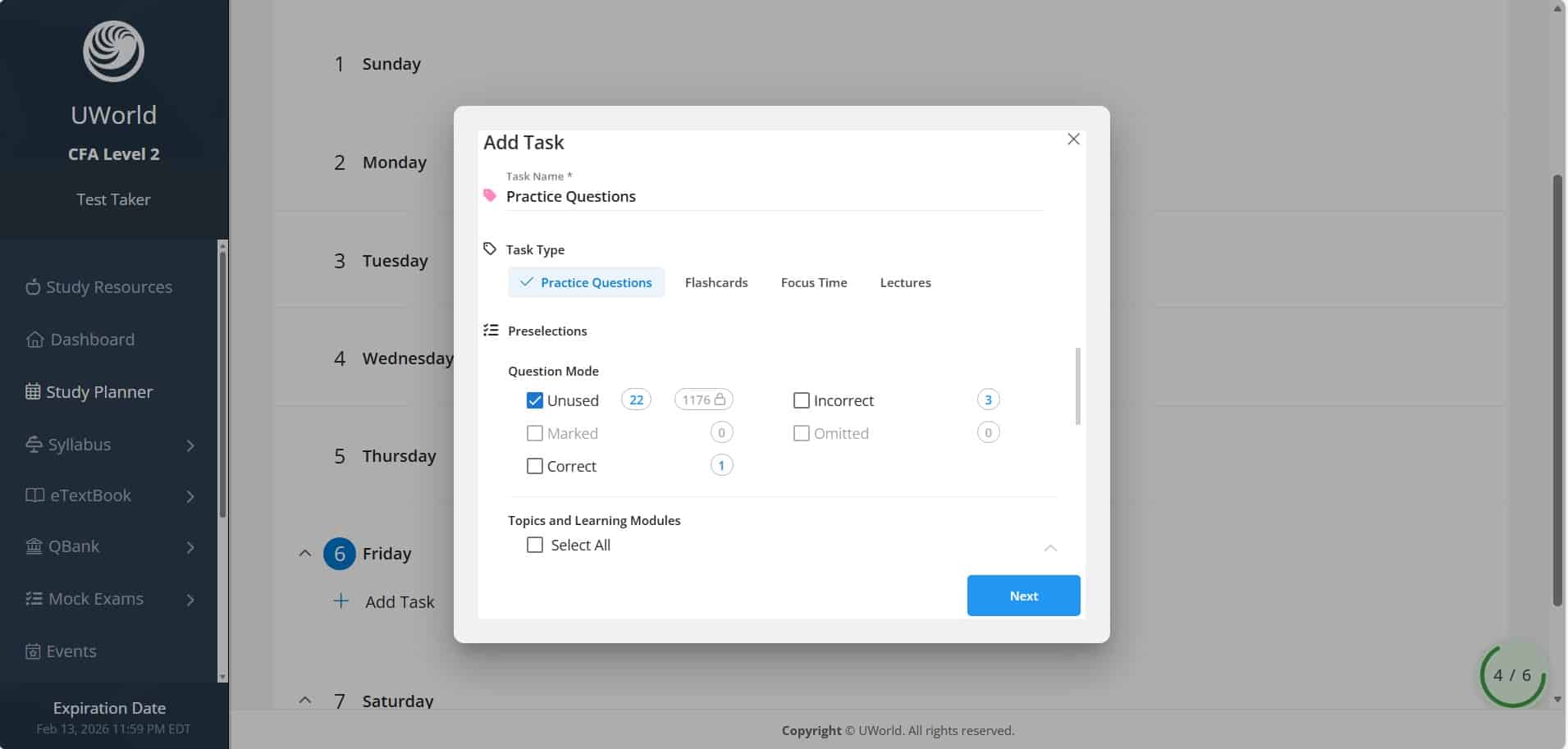
The course is built around practice questions first, then videos and reading second. That’s totally different from some other review course options that get you started with long textbooks.
UWorld has a custom quiz feature for adaptive learning, and to me, it was worth every penny. While studying, I found I could create quizzes on the topics I had trouble with. I was able to save a lot of study time and focus on the key areas I needed to improve, rather than rereading everything.
Tech, Videos, and Platform Experience
This is one area where I think UWorld performs really well. The platform loaded quickly, and I could easily understand everything on the dashboard.
The main menu made it easy to navigate to the question bank, mock exams, flashcards, or performance reports. It was easy to log in and get to work, whether I planned to study on my laptop, iPad, or iPhone.
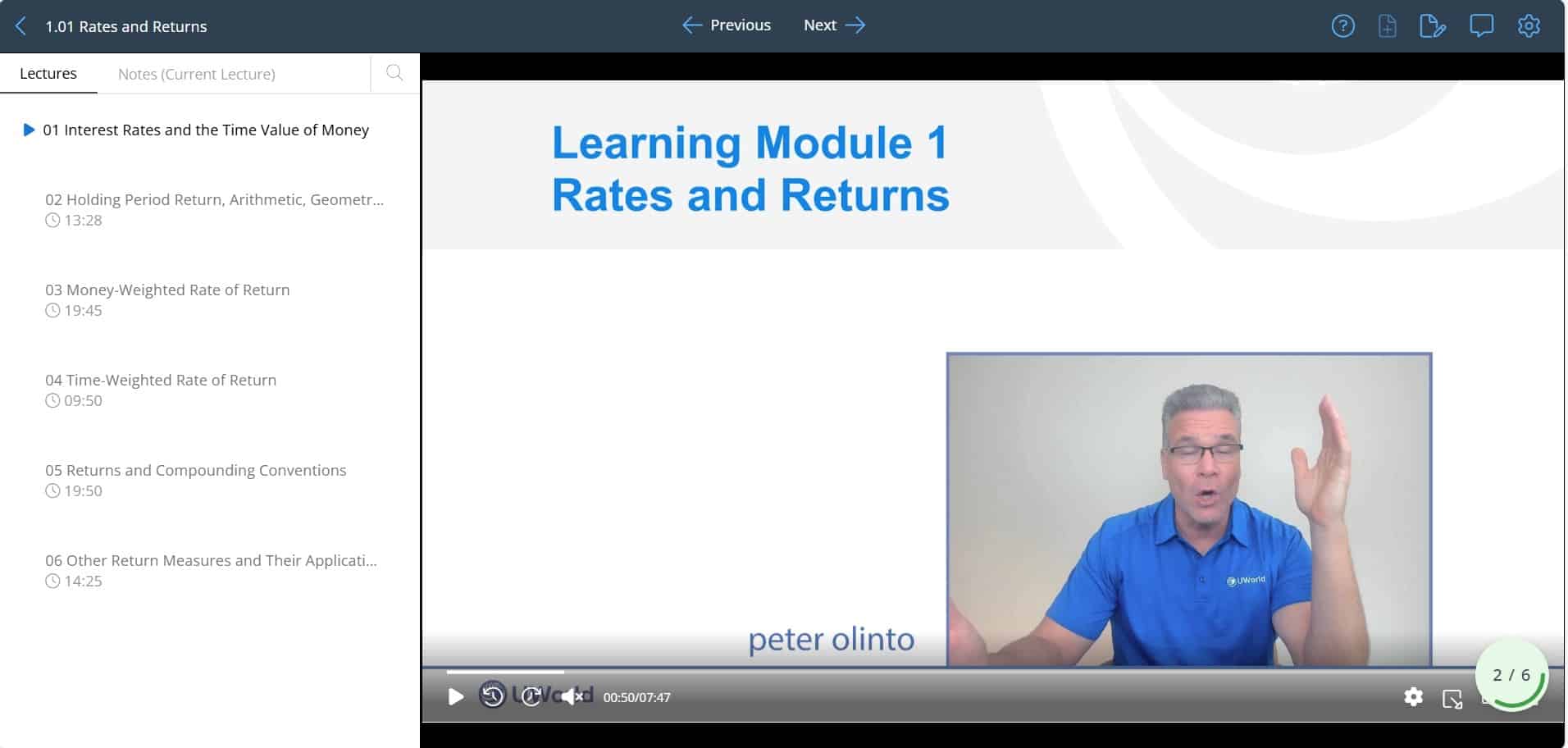
The videos are shorter than some other courses I’ve reviewed, but I really didn’t mind. I’m a huge fan of getting straight to the point and focusing on the essentials instead of having my ears talked off—and it made the experience more efficient. I truly felt like my time was respected.
It may seem small, but I also appreciated being able to change video speed and pause to take notes. It’s a feature I used when trying to cover some of the more difficult topics.
Value (What You Get for What You Pay)
In my experience, there are three ways in which this course delivers the most obvious value:
- The question bank
- The answer explanations
- The mock exams
By the time I completed about 50 tough questions, I had already started noticing patterns in how questions were written. Then there are the explanations. I’ve used other exam prep courses before, and many of them just tell you the correct answer and leave you to figure out the rest. This course does it differently—teaching you the actual concept, not forcing you to memorize buzzwords—and that has proven to be highly beneficial.
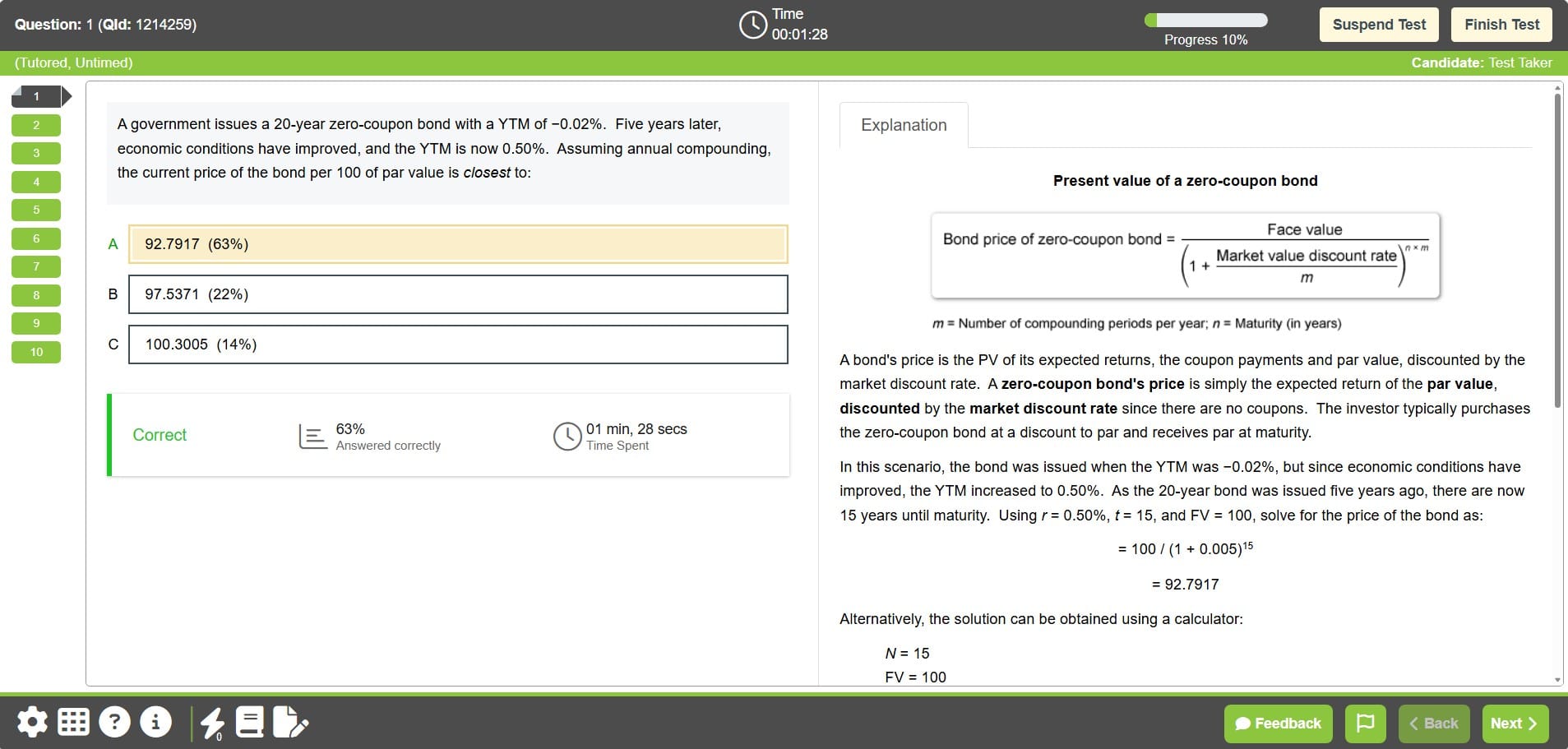
By the time I took my second practice test, it was blatantly obvious that I had gotten faster and spent less time second-guessing. The mock exams were probably the biggest confidence booster, considering that they showed me my score and where I still needed to improve.
The “access until you pass” guarantee in the Elite package is another worthy mention. For as long as you can provide proof of exam failure and comply with the conditions, you get unlimited access to UWorld until you pass the exam, relieving you of some pressure.
Support and Course Access
I’ve noticed that, of all the sections here, CFA candidates tend to be less interested in support than, say, practice questions or value; however, those who ignore it may find themselves paying the price when they’re stuck on a difficult topic. UWorld’s support service is pretty impressive, but only those with the more expensive packages enjoy it to the fullest.
In my experience, though, most students won’t really need it, especially if they use the question explanations and videos. But of course, it’s nice to know that help is available whenever you need it.
How UWorld Compares to Other CFA Prep Courses
UWorld vs AnalystPrep
After spending time with both courses for my CFA review, I found that UWorld and AnalystPrep are built for two different types of students. UWorld focuses more on practice, as the platform is built around its question bank for adaptive learning. The ‘big idea’ is that you learn better by answering questions and reading detailed explanations. So, each time I used UWorld, it felt like I was training aggressively for the exam. The questions were tough, yet the explanations made the material easy to build on.
On the other hand, from my AnalystPrep CFA review, it feels more like a traditional learning course. Like you’re probably very familiar with, it focuses more on video lessons and written notes first, then practice questions after. It was easier for me to follow AnalystPrep at the beginning, especially when it was my first time learning new topics. The lessons are straightforward, and the platform is simple, which some students may prefer if they don’t want too many tools or analytics.
- Choose UWorld if you learn by practicing and want very detailed explanations and strong mock exams.
- Pick AnalystPrep if you want a more affordable course and prefer to learn by watching videos and reading notes before practicing questions.
UWorld vs Kaplan
Kaplan is probably the most renowned CFA prep course provider, and after using both platforms, the structure was the biggest difference I noticed. During my Kaplan CFA review, it felt like I was in a classroom, more or less. It has a very structured study plan, large textbooks, live classes, and a more traditional teaching style. If you are the type who wants to be told exactly what to study each week and likes learning from instructors with a schedule in place for that, Kaplan does it really well.
Things are completely different with UWorld in that sense. It’s more on the flexible side of the spectrum and focuses more on practice and review. Rather than push you through long readings and lectures first, it’d rather get you into practice questions quickly and teach through explanations. Given that the CFA Level I is a multiple-choice exam, this should be a lifesaver for many. After all, the more you practice questions, the more comfortable you become with the test format.
- Choose Kaplan if you’re a student who wants structure and a learning experience similar to what you’d be subjected to in school.
- Pick UWorld if you’re a student who’s comfortable studying on their own and wants to focus on practice questions, mock exams, and performance tracking.
Bottom Line
UWorld CFA is effortlessly one of the strongest options for students who want to learn by practicing questions and reviewing detailed explanations. The platform provides useful tools to help you study efficiently and stay on top of your prep. If you’re self-motivated and want a course that mirrors the real CFA exam while giving you actionable feedback on every question, UWorld delivers.
It isn’t perfect; if you want a lot of 1:1 features, like tutoring and live classes, this isn’t the best fit. However, the core experience is highly effective and helps you master difficult topics with much more ease, giving you a real shot at success on exam day.
FAQ
Yes, but it’s best for beginners who have no issues with learning through practice questions. The explanations come in handy even if you’re learning difficult topics for the first time.
Yes, the Advanced and Elite packages let you participate in mock exams, and the Elite package has even more full-length mock exams for extra practice.
It depends on the package you choose, but the Elite package gives you unlimited access until you pass the exam (terms and conditions apply).
Yes, video lectures are included in the Advanced and Elite packages, covering difficult topics as well as important concepts.
There’s no absolute answer to that, as it depends on your learning style. While UWorld tops the list for practice questions and explanations, Kaplan is more structured, and AnalystPrep appeals more to those on a budget.