
How Long Does It Take to Become a CPA?
A lot of people ask how long it takes to become a CPA, as if there’s a clean, simple answer.
Unfortunately, there isn’t.
The timeline varies significantly from candidate to candidate, but for most people, this is not a quick process. It usually takes years—not months. But the payoff? A starting salary ranging from $70k to over $100k, according to Robert Half.
So, if you’re trying to figure out what the real timeline looks like, here’s what actually goes into it.
Key Takeaways
- There’s No Single Timeline: CPA requirements vary by state, so the time it takes depends on where you apply.
- Education Takes the Longest: Many candidates need a bachelor’s degree plus extra coursework to meet eligibility rules.
- The Exam Has Four Parts: You’ll need to pass all four CPA Exam sections, and each one takes planning, prep, and score waiting time.
- Licensure Usually Takes More Than the Exam: Many states also require work experience before you can become licensed.
- The Full Process Usually Takes Years: For most people, becoming a CPA is a multi-year process, not a quick certification.
How Long it Takes to Become a CPA
For many people, becoming a CPA takes several years—roughly five to eight years if you still need a bachelor’s degree, or one to three if you don’t.
You’ll usually need time for college, extra coursework if your state requires it, passing all four parts of the CPA Exam, and completing the work experience needed for licensure. The exact timeline depends on your state and how quickly you move through each step.
Some states let you sit while still enrolled, so taking the CPA exam as a college student can shave a year off the timeline.
Step 1: Earning the Education You Need
For most people, the longest part of becoming a CPA is the education piece.
A bachelor’s degree in accounting or a related field is typically the starting point for accounting careers. But for CPA eligibility, some states require 150 total semester hours, while some require fewer. States may also require specific accounting or business coursework.
That means your timeline might look something like this:
- About four years for a bachelor’s degree
- Extra time if you need more coursework to meet your state’s hour requirement
For some people, that extra coursework gets built into a master’s program. For others, it doesn’t. The big point is that many CPA candidates need more than just a basic bachelor’s degree to move forward.
Step 2: Qualifying to Sit for the CPA Exam
Once you meet your state’s eligibility rules, you can apply to take the CPA Exam.
This part can be quick or slow depending on your education status and your state board’s rules. Some states may also have requirements tied to age, residency, or specific courses.
To see how one board handles it, the Colorado CPA exam requirements lay out that state’s education, residency and experience rules in order.
So technically, “how long does it take to become a CPA” starts before the exam even begins. If you’re missing coursework, you may need to handle that first before you’re allowed to sit.
Step 3: Passing the CPA Exam
The CPA Exam has four sections:
- Auditing and Attestation (AUD)
- Financial Accounting and Reporting (FAR)
- Taxation and Regulation (REG)
- One Discipline section:
- Business Analysis and Reporting (BAR)
- Information Systems and Controls (ISC)
- Tax Compliance and Planning (TCP)
Each section is four hours long, for a total of 16 hours of testing time.
Of course, the exam itself is not just 16 hours of your life, and then you’re done. The real-time commitment comes from studying, scheduling, and waiting for scores.
You must score at least 75 on each section. And once you pass your first section, you usually need to pass the remaining sections within at least 30 months, though some states may allow as long as three years.
So the exam timeline depends a lot on how you approach it. Some candidates spread sections out. Others try to move through them as fast as possible.
How Long Does the CPA Exam Usually Take?
This is where people often want a more practical answer.
The actual testing time is 16 hours total. But in real life, most candidates need much longer than that once you factor in studying, scheduling, and score release timing.
AICPA says the Core sections are offered year-round with continuous testing. The Discipline sections in 2026 are offered in the first month of each quarter. That means test timing can affect how quickly you finish.
Score release timing matters too. Core section score releases are rolling throughout the year, while the 2026 Discipline section target release dates are listed for March 13, June 16, September 11, and December 15.
In other words, even if you feel ready, the calendar still gets a vote.
Step 4: Completing Work Experience
Passing the exam does not automatically make you a licensed CPA.
After the exam, you still need to meet your state’s licensing requirements. For many states, that includes work experience.
NASBA says many states require at least one year of public accounting experience. Other states may accept experience from teaching, self-employment, or part-time work.
This is a big reason the total CPA timeline can stretch out. Even after passing the exam, you may still need time to check the last box for licensure.
So, What’s a Realistic Timeline?
For most people, the path to becoming a CPA is not something you knock out in a few months.
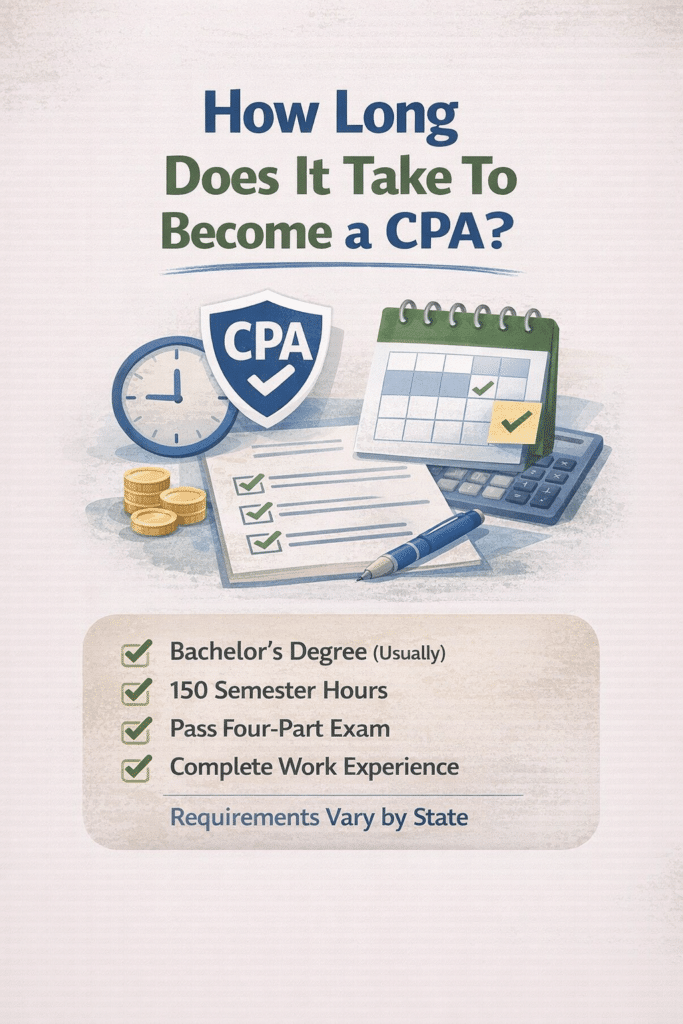
A realistic timeline usually includes:
- Around four years for a bachelor’s degree
- Additional time if you need more semester hours
- Several months to more than a year using a CPA review course and passing the CPA Exam
- About one year of work experience in many states
- Extra processing time for your final license application
That means the full timeline is often measured in years, not months.
If you want a one-line summary, it would be this: becoming a CPA usually takes as long as it takes to finish the education requirements, pass all four exam sections, and complete the experience required by your state.
What Can Make the Process Take Longer?
A few things can slow down the timeline:
- Needing extra coursework
- Delaying exam prep
- Failing an exam section and having to retake it
- Waiting on score releases
- Living in a state with stricter requirements
- Not completing work experience quickly
- Taking long gaps between exam sections
None of that means the goal is out of reach. It just means the CPA path rewards planning.
What Can Speed It Up?
A few things can help you move faster:
- Knowing your state’s rules early
- Planning your coursework in advance
- Starting exam prep with a schedule
- Taking exam sections close together
- Completing qualifying work experience as soon as possible
Basically, the more intentional you are, the less likely the process is to drag.
Is Becoming a CPA Worth the Time?
For many people, yes.
It’s a long process, but the CPA license can lead to stronger job prospects, more authority, and access to higher-level accounting and finance roles. It’s one of those career paths where the upfront pain may pay off later.
That said, it’s still a commitment. If you want the benefits of the license, you have to be willing to give it time.
Bottom Line
If you’re asking how long it takes to become a CPA, the best answer is that it usually takes several years and depends heavily on your state. The biggest parts of the timeline are your education, the CPA Exam, and the work experience needed for licensure.
The process is not quick, but it is clear once you break it into steps. If you know your state’s rules and plan ahead, the path can feel a lot more manageable.
FAQs
For most people, no. Even if you move quickly through the exam, the full process usually includes education and work experience requirements that take much longer.
The CPA Exam includes four sections, and each section is four hours long, for a total of 16 hours of testing time. In real life, the full exam process takes longer because you also need time for studying, scheduling, and score releases.
AICPA says candidates must complete all four sections within at least 30 months of sitting for their first passed section, though some states allow as long as three years. Because rules can vary, it’s smart to check your state board directly.
In many states, yes. NASBA says many states require at least one year of public accounting experience, though some states may accept other types of qualifying experience.
The biggest delays usually come from extra coursework, exam retakes, score release timing, and work experience requirements. State-specific rules can also make the process longer.

Kenneth W. Boyd is a former Certified Public Accountant (CPA) and the author of several of the popular "For Dummies" books published by John Wiley & Sons including 'CPA Exam for Dummies' and 'Cost Accounting for Dummies'.
Ken has gained a wealth of business experience through his previous employment as a CPA, Auditor, Tax Preparer and College Professor. Today, Ken continues to use those finely tuned skills to educate students as a professional writer and teacher.