
What Is A CPA License? A Career Guide
If you’re thinking about an accounting career, it’s easy to run into one big question fast:
What is a CPA license, and do I really need one?
The short answer: it’s a state-issued license for accountants who meet strict education, exam, and experience rules.
And yes, it can make a real difference in an accounting career.
In this guide, I’ll break down what it means, how it compares to being “just” an accountant, and what it actually takes to earn one.
Key Takeaways
- Higher Standard: A CPA license is a state-issued credential that shows advanced accounting knowledge and professional trust.
- Not The Same As Accountant: Accountants and CPAs overlap, but only licensed CPAs can perform certain regulated tasks.
- Career Boost: The license can support stronger job prospects, promotions, and earning potential.
- Requirements Matter: CPAs need to meet education requirements, pass the CPA Exam, have work experience, and receive state approval to qualify.
- It Doesn’t End at Licensure: Most CPAs must complete yearly continuing education to keep the license active.
What A CPA License Really Is
A CPA license is a professional license issued by a state board of accountancy. CPA stands for Certified Public Accountant. To earn it, you’ll have to meet education requirements, pass the Uniform CPA Exam, and complete qualifying work experience.
That sounds simple enough on paper. In real life, it’s a bigger deal.
That’s still solid work, and a lot of accountants build great careers without getting licensed. But having a CPA does set you apart. It shows that you’ve met a higher standard in terms of education, testing, and professional requirements. The basic distinction is simple: every CPA is an accountant, but not every accountant is a CPA.
And that matters because licensed CPAs can handle certain responsibilities that other accountants typically can’t, including:
- Conducting external audits and signing audit reports
- Certifying and submitting certain financial statements
- Representing clients before the IRS in ways tied to CPA authority
So if you’re asking, “What is a CPA license really?” one good answer is this: it’s proof that an accountant has met a higher professional standard and has legal authority for work that non-licensed accountants usually can’t perform.
Why A CPA License Matters For Career Growth, Salary, And Job Options
From a career angle, this is where the CPA license really starts to shine.
When employers see those three letters, they usually see more than test scores. They see commitment. They see technical knowledge. They also see someone who may be ready for more responsibility.
The designation is tied to trust, accuracy, and ethics. That’s a big reason it’s often called the gold standard in accounting.
That can matter a lot when trying to move up.
And it’s not some tiny club, either. According to the BLS, there are over 1.5 million accountants and auditors in the U.S., but there’s still a shortage that’s reportedly in a “crisis stage.” In other words, the license is common enough to be well known but selective enough to stand out on a resume.
If you want an easy comparison, think of it like this: an accountant can do a lot, but a CPA has a license that opens extra doors and comes with more responsibility.
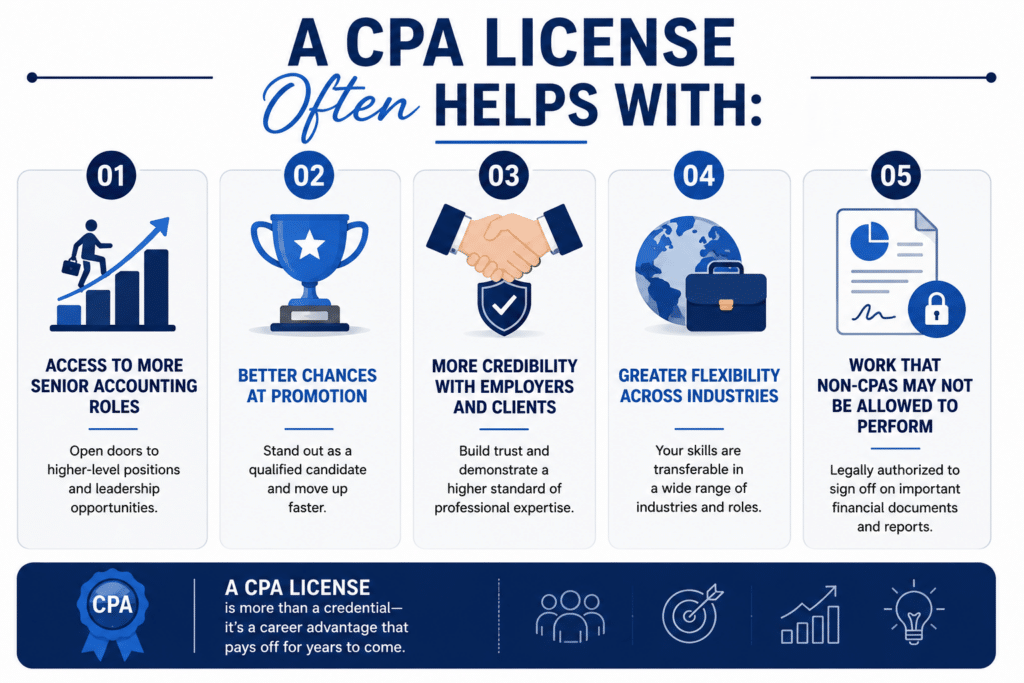
A CPA license often helps with:
- Access to more senior accounting roles
- Better chances at promotion
- More credibility with employers and clients
- Greater flexibility across industries
- Work that non-CPAs may not be allowed to perform
Many companies prefer or require CPAs for roles in audit, tax, compliance, reporting, and leadership. It can also help them move into jobs in public accounting, private industry, government, or consulting. That kind of range is valuable, especially if you don’t want to feel stuck.
And yes, money is part of it too. Pay can vary a lot depending on where you live, how much experience you have, and what kind of job you’re doing. But in general, having a CPA can make it easier to qualify for higher-level roles, which usually means better earning potential over time.
I think that’s one of the biggest reasons this license gets so much attention. It doesn’t just look good on LinkedIn. It can change the shape of a career.
How To Get A CPA License: Education, Exam, Experience, And State Requirements
If you’re interested in becoming a CPA, the process is manageable, but it’s not exactly a weekend project. It does take years to become a CPA, depending on what you’ve already completed.
The path usually includes four main pieces:
- Education
- CPA Exam
- Work experience
- State-specific licensing requirements
Education
First, candidates have to meet your state’s education rules. State boards set these standards, and they can vary. In general, the bar is high. That’s by design. A CPA license is meant to signal deep accounting knowledge, not just basic familiarity with spreadsheets and tax forms.
Before doing anything else, it’s smart to check the exact requirements for the state where you want to be licensed. This step can save a lot of future stress.
Pass the CPA Exam
Next comes the CPA Exam. This is the major test CPA candidates must pass. It’s one of the core requirements in every state licensing process.
The exam is known for being challenging, which is why many candidates use a recommended prep course and study plans. As a test prep expert, I’ve seen how much structured prep can matter. Trying to wing it is kind of like showing up to a marathon after jogging once. Bold strategy. Not ideal.
Experience
Most states also want you to have real work experience after the exam. A lot of them look for one to two years of accounting experience under a licensed CPA. The idea is pretty simple: it’s not just about passing the test, but also showing that you can do the work in a real-world setting.
That hands-on piece matters because accounting work often involves judgment, ethics, and detail under pressure.
State Requirements And Ongoing Maintenance
Finally, CPAs have to satisfy any extra state-specific rules for licensure. Since CPA licenses are issued by state boards, the details aren’t perfectly identical across the country.
And getting licensed isn’t the end of the road. To keep a CPA license active, professionals generally need to complete 40 hours of continuing education each year. That ongoing learning helps CPAs stay current with changing rules, standards, and best practices.
So, how do you get a CPA license? You meet the education standards, pass the exam, gain the required experience, and follow your state’s rules. It takes time, yes. But for many future accountants, the payoff is worth it.
Final Verdict
If you want to build a long-term career in accounting, getting your CPA is a smart idea. It can help you qualify for better roles, give you more credibility, and open up options you may not have otherwise.
Naturally, it takes time and effort; for a lot of people, however, it’s worth it. If this is the direction you want to go, the smartest move is to look at your state’s requirements and start mapping it out early.
FAQs
It’s a professional license for accountants who meet state education and experience rules and pass the CPA Exam.
Yes, many people work in accounting without becoming CPAs. But they may not be able to perform certain licensed duties.
In many cases, yes. It can qualify accountants for higher-level roles that often come with better pay.
It depends on education, exam timing, and experience, but it usually takes multiple steps over time rather than a quick finish.
Yes. State boards of accountancy set licensing rules, so candidates should always verify the requirements where they plan to apply.

Kenneth W. Boyd is a former Certified Public Accountant (CPA) and the author of several of the popular "For Dummies" books published by John Wiley & Sons including 'CPA Exam for Dummies' and 'Cost Accounting for Dummies'.
Ken has gained a wealth of business experience through his previous employment as a CPA, Auditor, Tax Preparer and College Professor. Today, Ken continues to use those finely tuned skills to educate students as a professional writer and teacher.